
Fifty years ago, the United States stunned the wine world by winning what became known as the Judgment of Paris.
It’s an improbable story, one that nearly didn’t come about. British wine merchant Steven Spurrier, who had a wine shop in Paris, had an American colleague, Patricia Gallagher, who’d visited Napa and returned to France impressed with the wines’ quality. The two cooked up the idea of an international tasting between American and French wines to mark the U.S. bicentennial.
The U.S. vs. the French
Spurrier traveled to Napa and picked six Chardonnays and six Cabs from selected wineries’ shelves, without revealing the purpose of the mission. He flew them back to Paris in cooperative passengers’ luggage. Then he picked comparable French wines and somehow convinced some of the most distinguished wine authorities in France to sit in judgment of the U.S. and French selections. It would be a blind tasting.
In the white category, when the wines were all tasted, the scores recorded, and the identity of the wines unmasked, the winner, with 14.67 points out of 20, was not one of the French Burgundies. It was the 1973 Chardonnay from Chateau Montelena in Napa, California. The U.S. also won the red competition.
Gallic apoplexy followed. There was no reasonable appeal or valid claim to fraud. The tasting was blind, and the judges were all French. While the French wine press didn’t publish a word, Time magazine published a small item on the unlikely results a couple of weeks later, titled the “Judgment of Paris.” The story immediately circulated in the wine world. From that day on, the U.S. wine industry was regarded differently in both France and around the world.
50 Years Later, in Rural Virginia…
All of which explains, in a way, why six of us are sitting around my dining room table 50 years and three weeks after the 1976 Judgment of Paris. Three glasses with about an inch of wine, each a slightly different tone of yellow, stand in front of us.
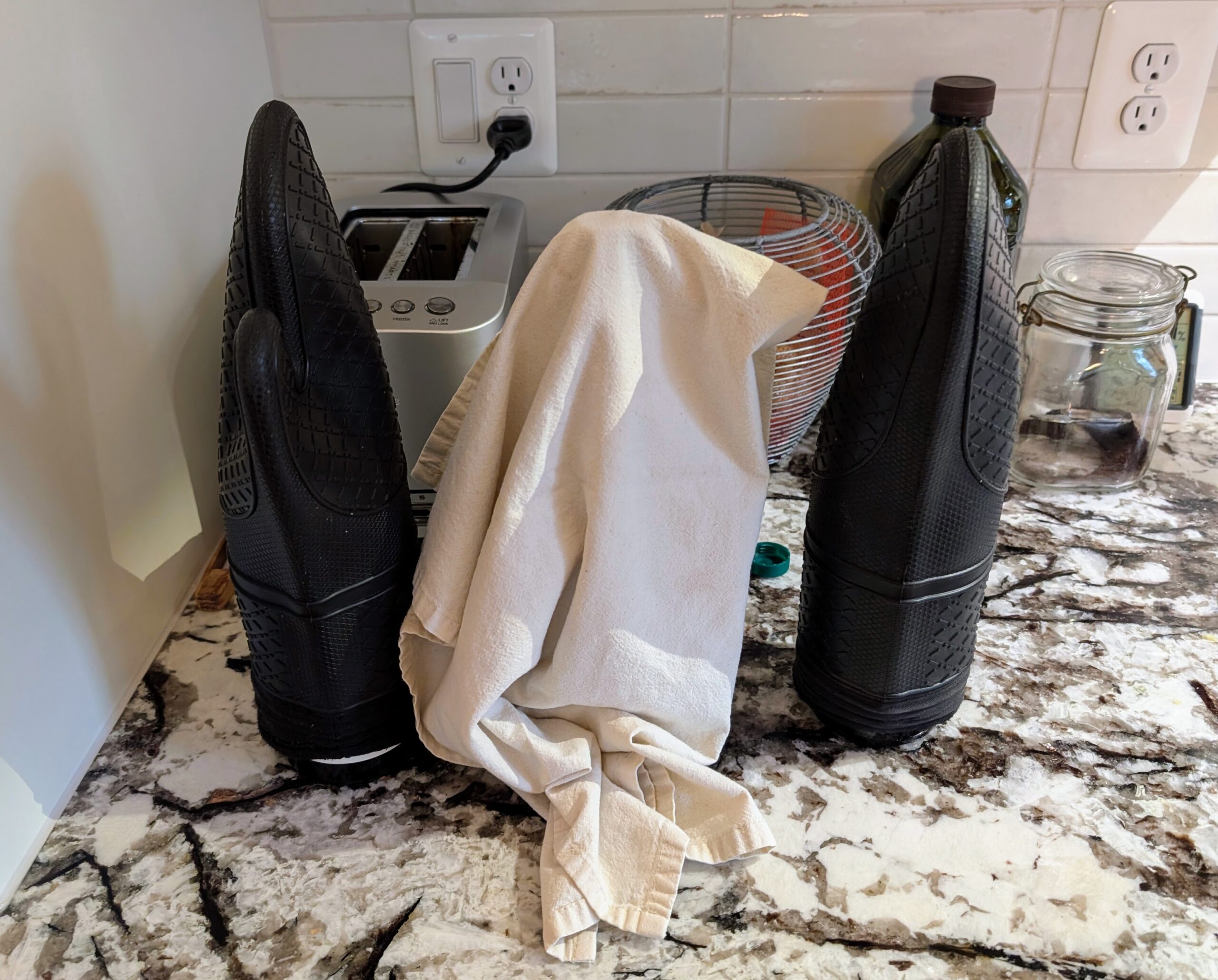
Over in the kitchen, three bottles stand out of view, two fully covered with oven mitts, one draped in a kitchen towel. One of them is the 2023 Chateau Montelena Chardonnay, the direct descendant of the wine that won the Judgment of Paris. Two are white Burgundies (which are 100 percent Chardonnay), stand-ins for the wines the Montelena competed against.
We are about to take our first sniffs.
Driving to Drink
Like the original Judgment, ours nearly didn’t come about.
One of the six of us sitting in judgment is my great friend Kevin, who has willingly appeared as my foil in several wine stories in this esteemed publication. Kevin has a sophisticated palate, deep knowledge about varietals and French appellations, a very thoughtful approach to wine, and no pretension about any of it.
When I emailed Kevin about this whole 50th-Judgment-anniversary tasting gambit, he was all in. I asked him to pick the two comparable bottles. Somehow, the wires got twisted in the communication. He showed up at my door with two reds.
I’m guessing you’ve never driven around the northern Shenandoah Valley looking for premier cru white Burgundies with four hours to do it. So you’ll have to take my word for it when I say that there are very few haystacks and even fewer needles out here.
What Are the Chances?
As it happened, my lovely wife and I had been out drinking one night, not too long before all this, in a nearby hamlet. We sat at the bar of what’s claimed to be the oldest motor inn in America, and one of the guys there said he owned a wine store in town. He seemed to know a great deal about wine, though he was surprisingly gruff and dressed like a fellow who’d just driven a forklift.
I remembered this fellow as Kevin and I started sleuthing. Sure enough, Timeless Wines in Middletown, Virginia, just a couple of blocks down from the motor inn, unexpectedly had a massive online selection of wines from around the world. It included many impressive Burgundies. Kevin and I jumped in the car and headed to Middletown.
Unfortunately, the small storefront was set up for local retail traffic only, with no bottles meeting our needs. Joshua and Anna, the young attendants, explained that the wines we were looking for were in the warehouse, located just outside the window. They can only be ordered online, however; the earliest we could get those bottles was Monday. This had to do with Virginia alcohol laws and so forth. To their great credit, they did an excellent job holding the line, ensuring the store stayed on the right side of the law.
Yet Kevin is a highly accomplished lawyer in Washington, D.C., and knows how to navigate thickets like this.
A Timeless Solution
To keep the story short, as we drove around the farmland and towns of Frederick County, Virginia, Kevin somehow managed to get the importer of the bottles we were looking for on the phone; the importer, Kysela Pere et Fils, sympathetic to our cause, connected with his customer, who was, as it turned out, the owner of Timeless Wines. They devised an ingenious and perfectly kosher way to sell us the bottles for pickup in time for our tasting.
The owner of Timeless—Mike Good, the guy Pam and I had met at the bar—talked with Kevin to alight on just the right Burgundies to make a fair match with the Montelena. With the help of Mike’s digital magic, we placed the online order from the car and slipped back into the retail shop for pickup as the clock ran down. We drove away with four bottles in a paper bag, two each of some pretty impressive Burgundies. We had an hour to spare.
(If ever you’re looking to order fine international wines from a massive, hand-picked selection, Timeless Wines is the place to go. Thanks, Mike!)
Time to Swirl, Sniff, and Sip
Back at our table, there were six of us: Kevin and his wife, Alison; our friends, Yves (representing his home country of France) and his wife, Katie; and my wife, Pamela, and me. It was time to taste.
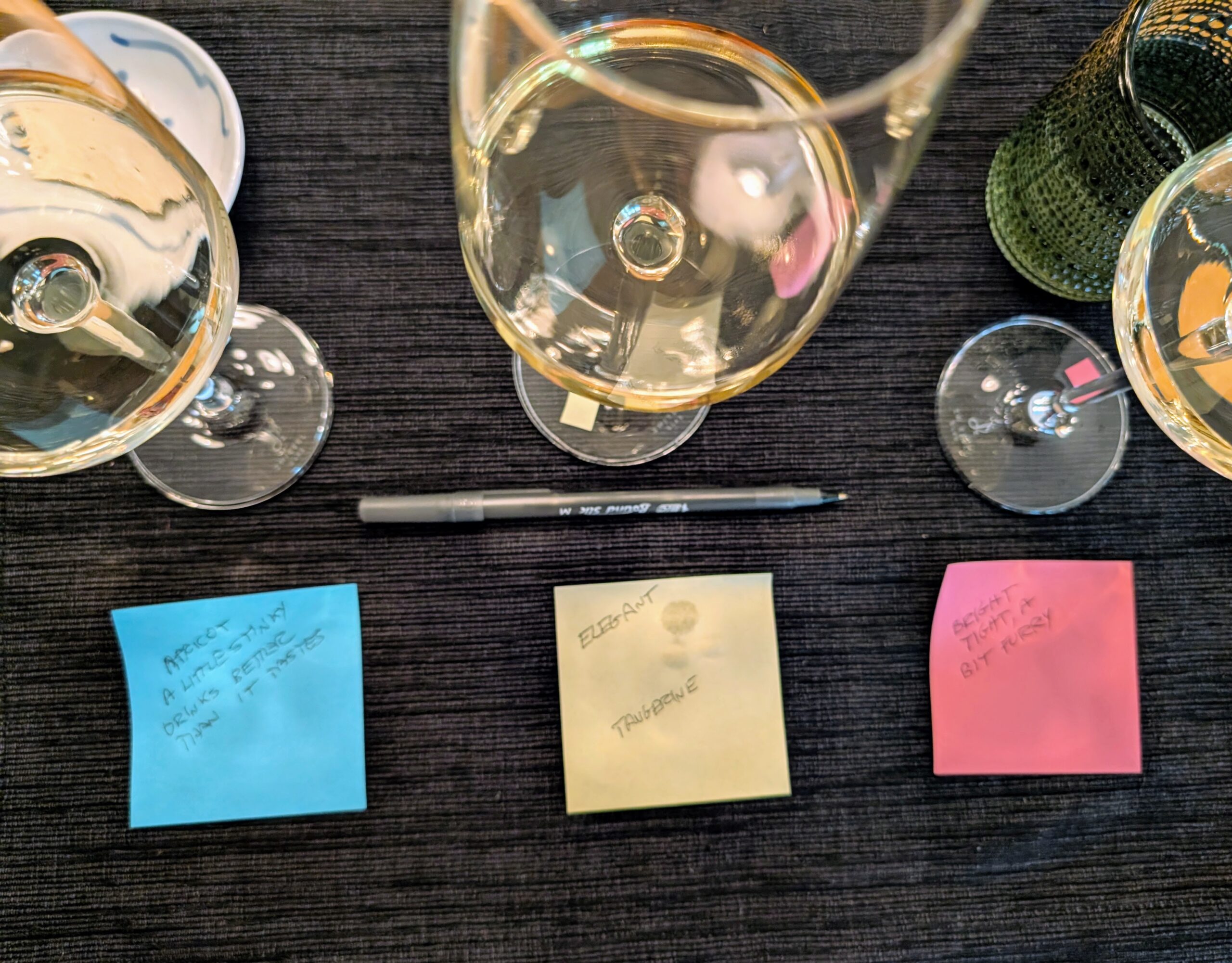
Each glass had a small colored label on the base: yellow, red, or blue, representing the wine inside. Each of us had our wines in a different sequence. (Pamela, who poured the wines and arranged the table, is a psychologist well trained in the social sciences and was determined to avoid order bias.) In front of each glass was a sticky note of the same color for recording observations.
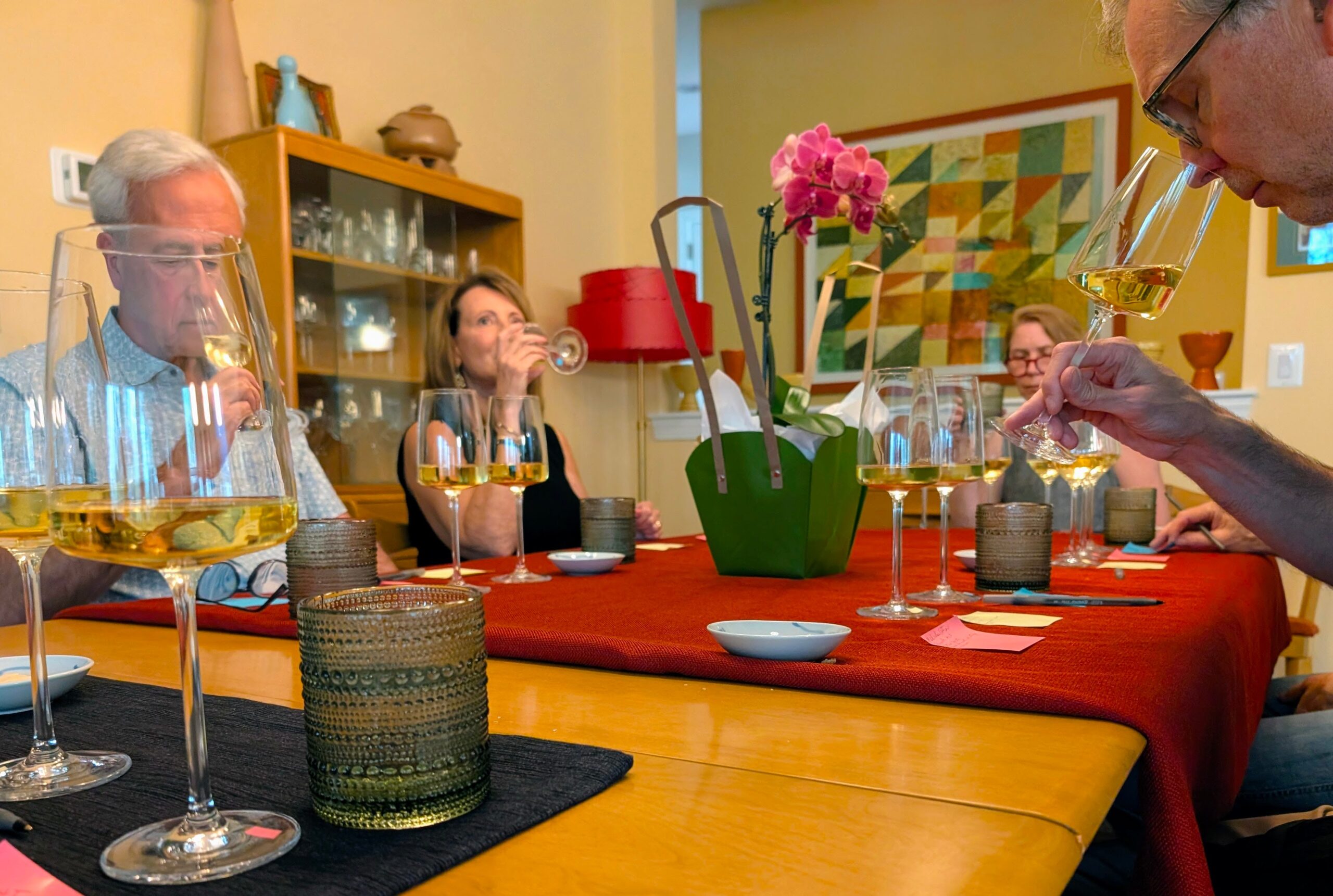
I briefly recapitulated the story of the Judgment and its anniversary to our guests, and explained our mission. We would simply order our wines in preference, first, second, and third, and record our thoughts about each. Then I turned everyone loose to swirl, sniff, and sip.
We were to do so in monklike silence, so we didn’t influence each other.
Judgment Time
Our silence was broken only by mutterings of how hard it was to pick our favorites. The wines were in many ways similar to each other, at least to our not-distinguished-French-judge palates. The final numbers would validate this.
One by one, we finished our task. We turned in the colored markers from each glass to Pam, in order of our preference, and she transferred them to a scoring sheet. A grid of lines and colors began to take shape. It was like CNN on election night.
In the end, the winner…wasn’t Montelena. The Judgment of the Shenandoah Valley would not be a repeat of the Judgment of Paris.
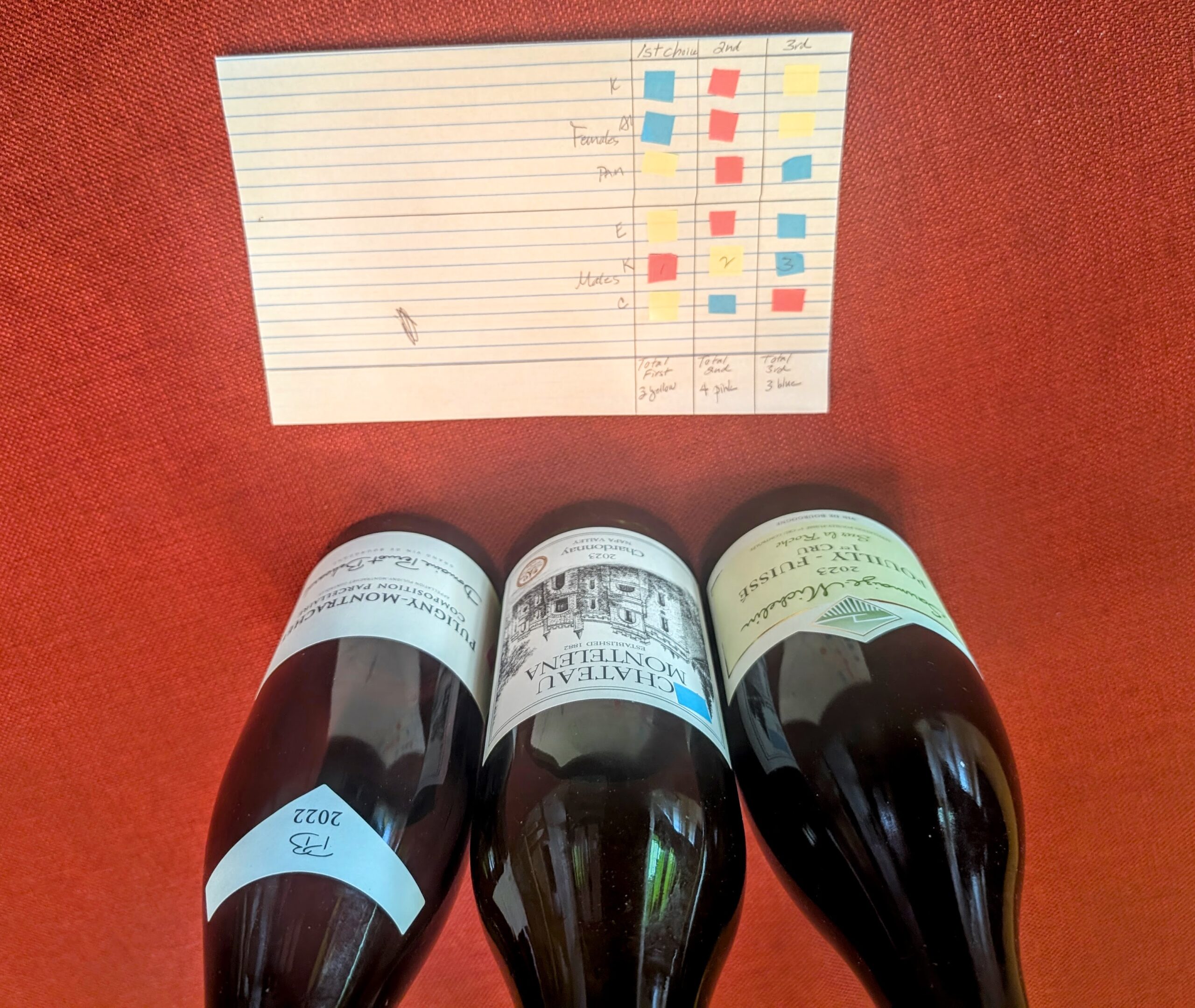
But the scores were very close. Awarding three points to first place, two to second, and one to third, the first and last place wines were separated by only two points. There were 13 points for yellow, 12 for pink, and 11 for blue.
Looking only at first-place votes, yellow received 3, blue 2, and pink 1.
And the Winner Is…
When the bottles were unmasked, the group’s top choice, wearing the yellow frock, turned out to be a 2023 Saumaize-Michelin Pouilly-Fuisse Premier Cru Sur la Roche.
Our judges found it “elegant…rounder…tangerine…lasting taste, friendly…lemon, lingers the longest…tart…very dry, acidic…medium malolactic fermentation (that was Kevin).
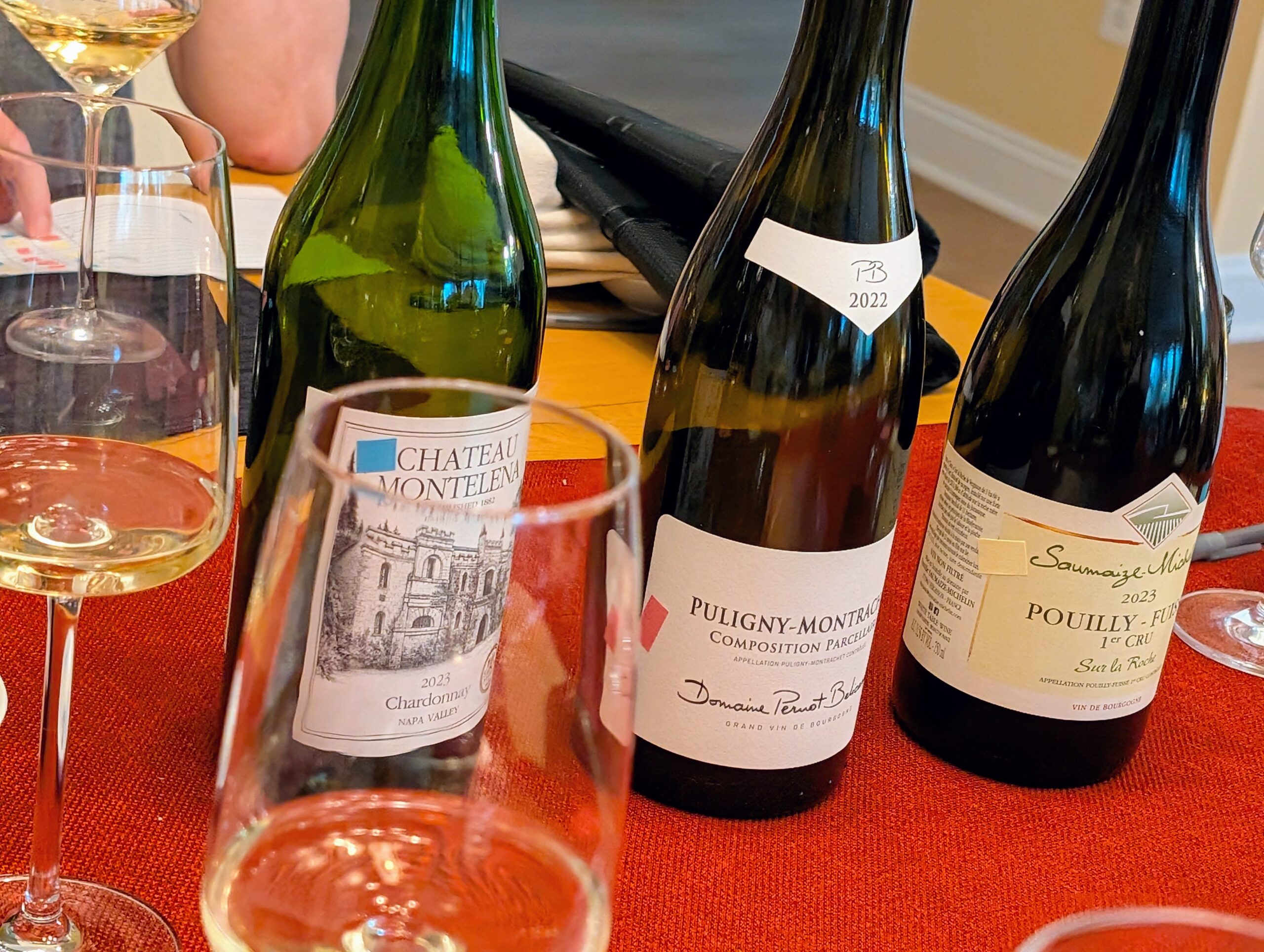
Here’s what the importer — the company of the guy Kevin talked to on the phone! — says about the winning wine on its website:
“Produced from the oldest parcel of the estate dating back from 1979 and planted on the slopes of the Vergisson Rock, ‘Sur la Roche’ benefits from a south sun exposure. This beautiful Chardonnay offers abundant floral and white fruit aromas, toasty and buttery notes and brioche scents. Well-balanced and concentrated on the palate with a rich structure and refreshing notes of zesty lemon and mineral purity that brings a vibrant energy to the finish.”
Wine Enthusiast gave it 92 points. It costs $65 at Timeless Wines, up to $105 elsewhere.
The Bottle in the Middle
Next comes our second place bottle, wearing the pink tag, which won one first place vote and four second-place votes.
It was a 2022 Puligny-Montrachet Composition Parcellaire from Domaine Pernot Belicard (about $90).
“Pear, slightly effervescent…smooth, lovely, evanescent…nose: spicy citrus…nicely round, bright”
Fittingly for a wine that performed as the “middle child,” two of its sticky notes were returned with no observations at all on them.
In order to give this wine its due, I asked Claude, my favorite AI tool, to compress international critical consensus of this wine into a haiku. Here it is:
Green apple, flintstrike—
tensile freshness on the tongue
Zen-like to the last
Judging the Judgment Winner
My first written observation of the blue-tagged wine, the Montelena, which came in third place, just one point behind the Zen-like Puligny-Montrachet, was this: “Apricot, a little stinky.”
I need to explain.
First, the apricot. I always try to capture my first whiff before I have time to think — the hit of aroma I get when the glass passes under my nose for the first time. I got apricot.
Now, “a little stinky.”
I’ve been wrestling with this one for a while. “Stinky” is my shorthand for a very specific smell whose origin I haven’t been able to determine. It’s not entirely unpleasant. It’s a slight funk, maybe vegetal, a little stemmy perhaps. When I try to visualize it, I think maybe of the inside of grape skins. I tend to prefer clean wines, but I like some slightly funky ones too. This one bore a bit of funk.
Drinks Better Than It Tastes?
Later I wrote it “drinks better than it tastes,” though I’m sure I meant “drinks better than it smells.” In other words, the slight funk on the nose didn’t show up on the palate.
I made it my number two choice.
Nobody else detected any funk. Other comments on the Montelena:
- Warmer, grapefruit, vanilla, #1
- Smoother, softer, sweet but not too sweet
- Herbal background
- Not much personality, but easy, pleasant
- Nose: paperboard; thinner than others; balanced, piquant finish. Medium malolactic fermentation. (That was Kevin)
Ladies’ Night
As I mentioned, Pamela is trained as a social scientist. She wanted to distinguish between male and female responses to see if there were any differences.
There were.
It turned out that the Chateau Montelena Chardonnay, the preference of the sophisticated jurists in 1976, was the ladies’ choice in the Shenandoah Valley. Two of three women considered the Montelena the best bottle. A tiny sample size, but still.
Kevin, both male and the most experienced taster of Burgundies among us, thought the Montelena’s profile “lacked the depth of the others.” His summary, in an email after our judgment:
“For me, the tasting demonstrated the overall superiority of these French wines….Had Montelena had a full flavor and tasting arc (nose, palate, finish) while presenting a different style or philosophy of wine, that’s a difference I can fully respect. But thinness is not so good. It will be interesting to see how the wine fares in a couple more years.”
More on Montelena
There is more to the Montelena story, about why this whole tasting enterprise was so challenging, and why the scores were so close.
Unlike a lot of Napa winemakers, Montelena has always been dedicated to making leaner, brighter white wines. These are very different from the oaky butterbombs for which California Chardonnays are so well-known. (Wine geekery: Montelena has always used little malolactic fermentation — Kevin nailed that one. That’s the practice by which many familiar Chardonnays take on their characteristic richness. This method allows more fruit and minerality to come through.)
This was true back in 1976, which may explain why its wine compared favorably to the Burgundies, which also don’t use much malolactic fermentation and tend to have a similar lighter, elegant profile. And it’s true today, which may explain why it was hard for us to distinguish among three wines that share a basic winemaking approach.
Tasting History, Not Trends
Montelena is not the flashiest or most coveted name on current “best of” Chardonnay lists, where the spotlight has shifted toward tiny-production cult bottlings. Its reputation rests not on scores, but on history and consistency. (The same family still owns the winery as in ‘76.)
I turned to Claude again, this time to summarize professional wine critics’ assessment of the ‘23 Montelena Chardonnay:
“The 2023 Montelena Chardonnay scored 93 from Wine Advocate, marking it as one of the best vintages in a decade. Critics praised its bright acidity, minerality, and tension, with pear, lime leaf, and flinty character. Not a blockbuster — a precisely built, age-worthy wine that refuses to follow California convention.”
Montelena’s winemaker, Matt Crafton, was studying economics at the University of Virginia in the early 2000s when he found a letter from Thomas Jefferson to George Washington. He became interested in Virginia agriculture. After graduation he bagged the business career plan and went all in on wine.
His first wine job? In the Shenandoah Valley.
You might also enjoy:
Craig Stoltz, senior editor of FWT, writes the Substack newsletter Eat the World.
