
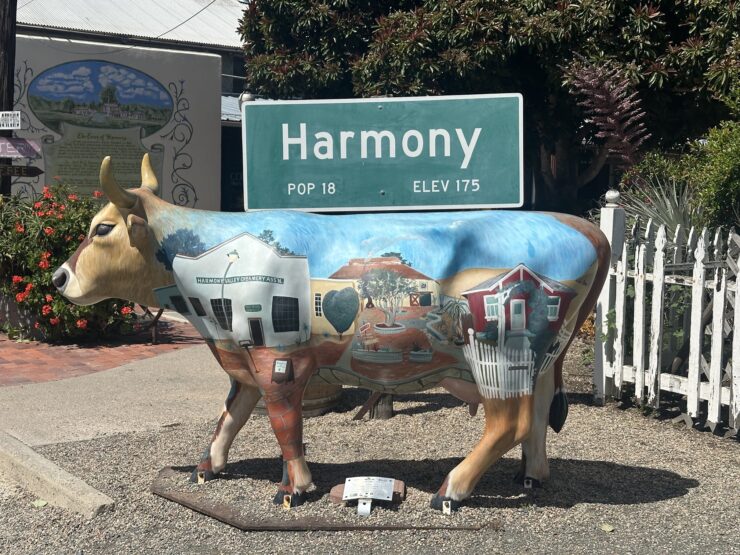
Driving north on California Highway 1 recently, I turned into Harmony, one of California’s smallest towns with just 18 residents, according to the sign. My spontaneous decision to explore was worthwhile—Harmony’s few businesses include a standout winery, Harmony Cellars.
Central Coast Bound
My oldest friend and I always look forward to a short getaway together. I’m in Los Angeles; she’s in San Francisco. California’s Central Coast is an ideal spot for our rendezvous, approximately a four-hour drive for each of us. This April, we chose to meet in Cambria.
This idyllic small town on the Pacific Ocean has everything we need: affordable inns, a variety of good restaurants, ocean-front hiking trails, winery tasting rooms, and shopping galore, including many thrift shops.
In Need of Wine
As I traveled north, my friend said she’d reach the Cambria Pines Lodge a couple of hours after me. I decided to stop in Harmony to pick up a bottle of wine after hearing good things about the winery from friends in LA.
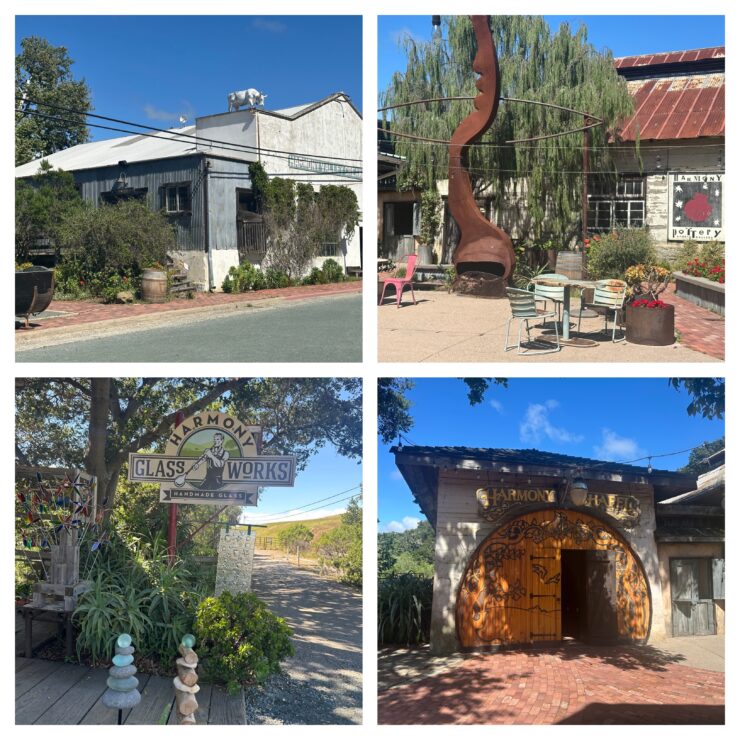
The entire town is about 2.5 acres, or one block. My visit started by checking out the few businesses there. After poking around in Harmony Pottery Studio and Gallery, I bought a few lovely pieces. I ordered tea at the delightful Morii Coffee shop. A glassblower was at work at Harmony Glass Works, and I bought some colorful glass chimes. While wandering through the Harmony Chapel and Gardens, I even got to see (and hear) the jets from nearby Vandenberg Air Force Base practicing their maneuvers (very loudly).
A stone’s throw away from the town center and up a small hill sits Harmony Cellars. To kill time before my friend arrived, I decided to check it out and purchase a bottle of wine for our first night in Cambria.
This small rustic setting offers a well-appointed tasting room. It includes a bar for stand-up tastings and a gift shop chock full of fun wine-related items. There are also two outdoor areas: a covered pavilion with comfy couches offering amazing views, and another grassy area with open-air seating.
Before Harmony, Shooting
The town of Harmony dates to 1869, when Italian-Swiss farmers built the Harmony Valley Creamery, which produced butter and cream. Per Brian Mulligan, VP of Harmony Cellars and the owner’s son, the name “Harmony” has a story.
“Technically, the town is named after people deciding to stop shooting at each other,” he explained. There apparently had been a feud among cattle ranchers in the area that, per legend, went badly before things worked out.
“The dairy business thrived until the 1950s, and then Harmony fell asleep for a while,” said Brian. In the 1970s and 1980s, artists and small businesses brought Harmony back to life.
“Today you will find pottery, glass blowing, wine, and a handful of spots that make it feel like a tiny, living postcard,” he said.
Swapping Dairy for Wine
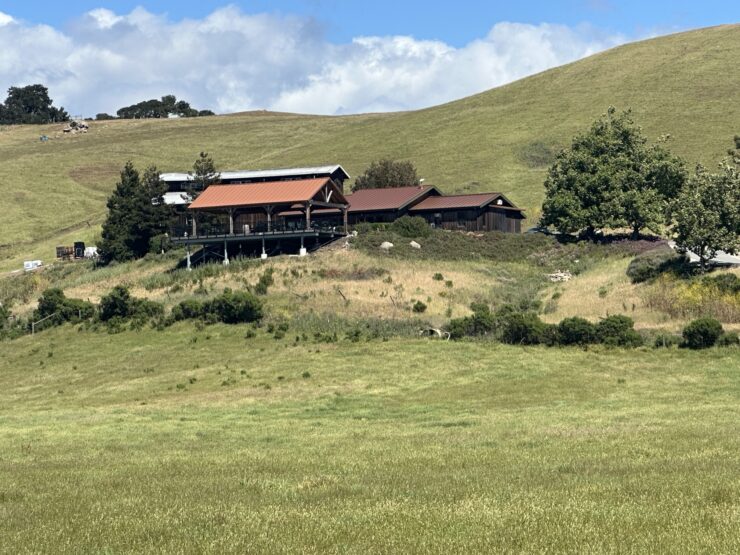
Harmony Cellars, while relatively modern, has a story that goes back well over a century.
The winery was founded in 1989 by Chuck and Kim Mulligan, Brian’s parents. Chuck holds a degree in enology from Cal State Fresno. He worked as an assistant winemaker at Estrella Winery in Paso Robles, about 30 miles east of Harmony.
While assisting at Estrella, he made small batches of wine on the side and did consulting work. This eventually led the Mulligans to start their own label.
The winery sits on land that has been in Kim’s family for four generations. It is part of the original Giacomo Barlogio holdings tied to the Harmony Creamery days. Barlogio, who is Kim’s great-grandfather, was one of the founding Swiss-Italian families.
He purchased 750 acres of land from media tycoon William Randolph Hearst. Hearst’s opulent castle is located in San Simeon, another tiny coastal community, approximately 14 miles north of Harmony. Hearst Castle is one of the Central Coast’s biggest tourist attractions.
Barlogio had a bit of a rebellious streak, according to his great-great-grandson Brian. “During Prohibition in the U.S., he was making Zinfandel in his basement and, from what I heard, would sneak his grandchildren down there, including my grandmother, to taste his ‘very illegal but very important’ wine.”
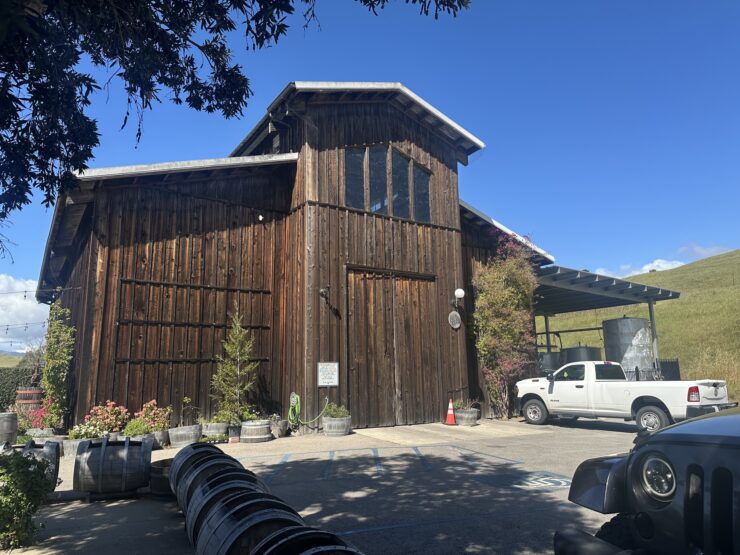
The winery production building was completed and opened in 1994. This rustic, unpretentious building is, as the younger Mulligan says, “rooted in the landscape.” The surroundings are classic Central Coast—rolling hills and grazing cattle. But you won’t see vineyards.
All grapes that go into Harmony Cellars’ production facility are sourced from other growers.
As Grassroots as It Gets
Harmony Cellars began life as a micro-production winery, producing around 2,000 cases per year. Originally, the Mulligans rented a facility in Paso Robles and had a tiny tasting room in downtown Harmony. “It was never a big, flashy startup,” says Brian. “It was built slowly, hands-on, and very intentionally.”
Today, Harmony Cellars is a boutique operation, producing around 6,000 cases annually. It can go up to 10,000 cases per year under its license, and the winery plans to get there slowly and intentionally.
The winery offers a wide range of varietal wines made from grapes sourced from throughout the Central Coast.
Ideal Setting, No Grapes
“One of the most common questions we get at Harmony Cellars is why we don’t have vineyards planted on the property, especially given how ideal the setting looks,” says winemaker Chuck.
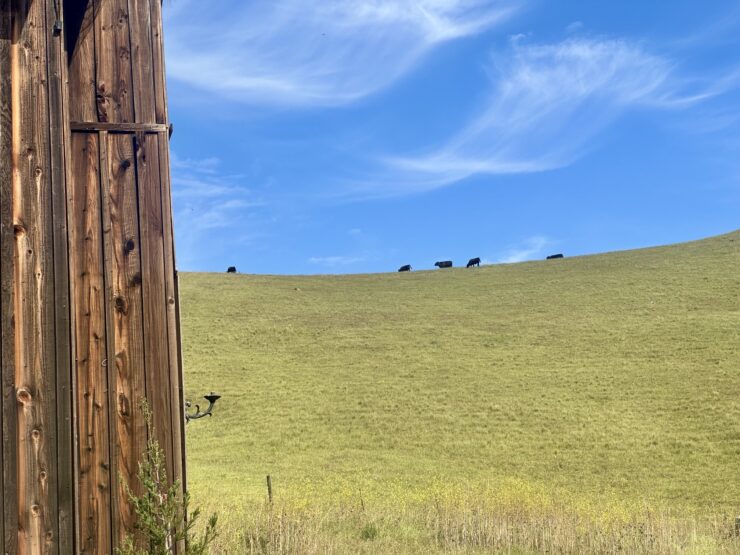
Blame the serpentine soil, which contains unusually high levels of magnesium and heavy metals. These soils are notoriously difficult for agriculture. Grapevines struggle to survive in it. Hence, there are no “estate wines” at Harmony Cellars.
But you do see lots of grazing cattle.
Opportunities and Challenges
The Mulligans source their grapes from growers in Paso Robles and elsewhere around the Central Coast, with whom they have partnered for years. “These long-standing relationships are a big part of what allows us to maintain consistency and quality in our wines,” says Chuck.
He feels this arrangement gives them flexibility, as they can draw from a variety of vineyard sites and microclimates, allowing them to produce a diverse lineup focused on sourcing high-quality fruit.
This business model also has its challenges. Namely, needing to search for new sources when old sources change direction. Secondly, it’s about pricing, which is influenced by the broader market. With California’s current oversupply of grapes, prices are down, which is working in Harmony’s favor.
European-Style Wines
“My winemaking style definitely leans more European in philosophy,” says Chuck. That means lower alcohol, more balance, structure, and drinkability. He wants people to enjoy his wines—on their own or with a meal, whether seasoned wine drinkers or newcomers to wine.
Chuck’s biggest early influence was Tom Myers of Castoro Cellars in Paso Robles, who he says reinforced the idea that balance and quality fruit should always come first.
It’s All About the Fruit
For his quality fruit, Chuck goes inland to Paso Robles for his red grapes and a bit further north to Monterey County for his white grapes.
The cooler, marine-influenced Monterey terroir helps preserve acidity and structure, yielding nice, clean fruit in his white wines.
Most of Harmony’s reds are sourced in Paso Robles. Chuck says he gets very specific about which districts within the larger Paso Robles AVA he chooses, as each brings something unique.
Mulligan sources Syrah (used to make Rosé) and Barbera (a northern Italy variety) from the San Juan Creek District of Paso. This district gives him bright fruit and good natural acidity.
Harmony’s Zinfandel grapes are from the Adelaida District of western Paso. The area has good elevation, ocean influence, and limestone-rich soils, which combine to produce good concentration and structure in the grapes.
Other grapes from the warmer Estrella district include Cabernet Sauvignon, Petite Sirah, and Tannat. The fruit from here is ripe, deep in color, and has bold flavors.
Chuck’s Syrah, Petit Verdot, and Malbec come from the Geneseo District, known for diverse soils and microclimates. The Spanish white grape Albariño is also sourced from Geneseo.
“At the end of the day, it’s less about chasing a specific vineyard name and more about consistency and relationships . . . trust is key,” says Chuck.
Diverse Lineup
Harmony’s lineup is quite diverse, providing something for every palate.
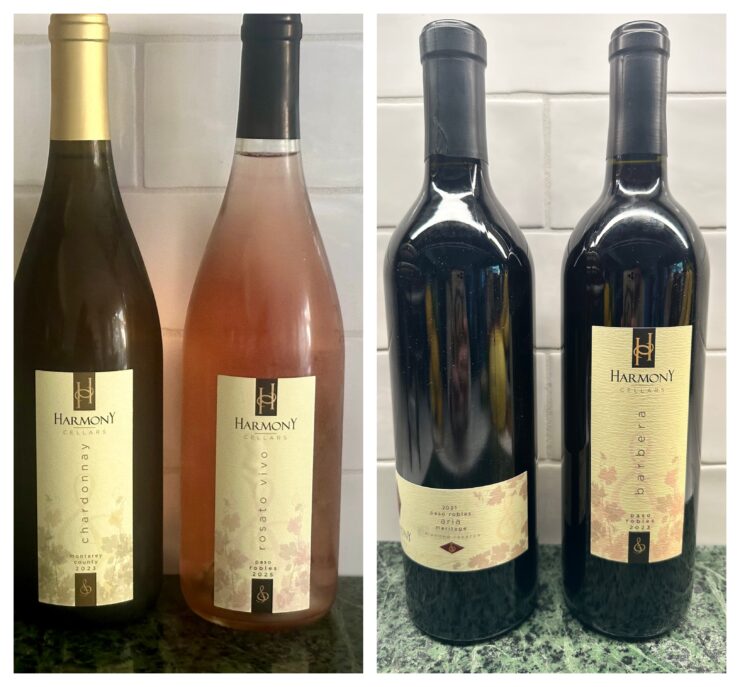
The flagship white wine is Chardonnay. Made in the Burgundian style, this white, barrel-fermented wine is aged on its yeast (‘lees’). It shows a touch of oak and butter. Though from California, it offers a lighter, European style. Another popular white is an off-dry Riesling.
Rosato Vivo is a Syrah-based Rosé wine. This translates to “lively rosé” in Italian, and it lives up to the name. It’s slightly off-dry, with a mouthwatering fruit salad palate that’s perfect on its own or paired with just about any dish.
Reds include their best-known Aria Meritage. This Bordeaux-style blend (meaning the same grape varieties as in Bordeaux, France) features Paso Robles Cabernet Sauvignon, Petit Verdot, Malbec, and Merlot, with lots of baking spices and red and purple fruit. My husband noted a smokiness and some dried fruit in this wine.
Harmony Cabernet Sauvignon is classic European-style with cherry, licorice, dark fruit, velvety tannins, and a long finish. The Zinfandel is classic California, with jammy fruit, including raspberry, blackberry, and cranberry. This bottling is a tribute to Kim’s great-grandfather, the basement winemaker.
Two Favorites
I shared a bottle of both the Rosé and the Barbera with my husband, and both are now favorites of ours. The Rosé is a perfect summer (or any time of year) sipper. It’s slightly off-dry, giving it a luscious mouthfeel, with notes of strawberries and tropical fruit. The Barbera is an outstanding example of old-world northern Italy meets the new world, Paso Robles. This vibrant and fruity red has tangy acidity, making it a great food-pairing wine. It’s light enough to be refreshing, but rich in complexity. My husband noted aromas and flavors of black currant, cherry, and cranberry, a wet-rock minerality, and chocolate.
A Second Visit
I was so enamored of my solo visit to the winery that I returned two days later with my friend. We opted to stay close to the coast, rather than go inland to Paso for a tasting. She did a full tasting at the indoor tasting room while I sipped a glass of the Rosato Vivo on the sunny grass terrace outside. (One glass was my limit as I was driving.)
©Terry Nozick
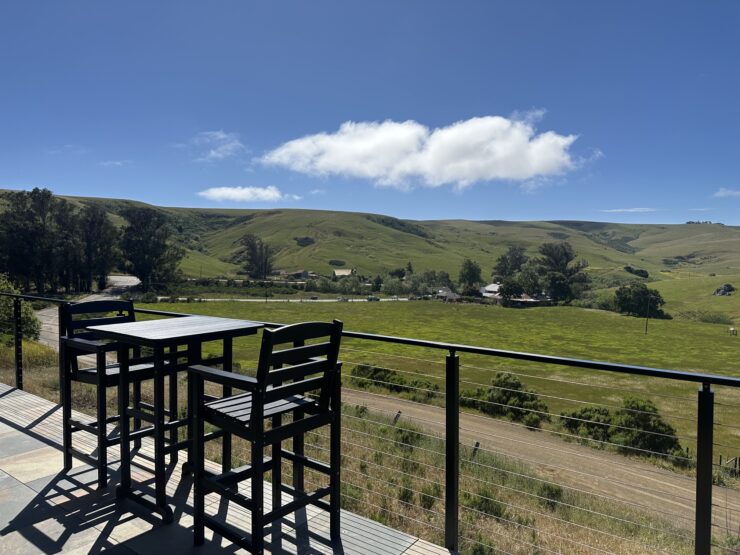
The winery setting is all about relaxation in a natural environment. The rustic setting of the winery includes a large Pavilion with comfy seating and high-top tables.
Every area has open vistas, overlooking the small town and acres and acres of rolling green hills. There are cows and grass as far as the eye can see. Wind was a bit of an issue in April, reminding us that Spring on the California Coast can be a bit nippy.
To the side of the main tasting room building is a more protected seating area with outdoor couches spread across a lawn.
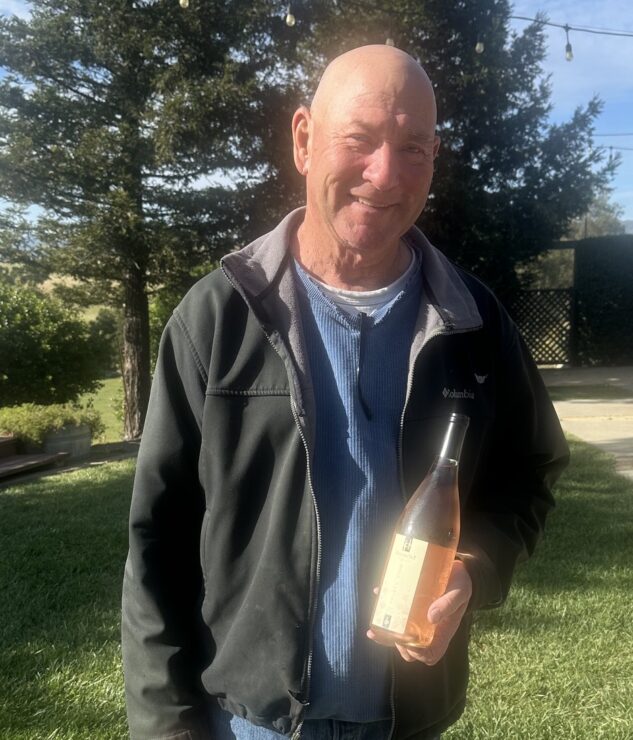
It was here that I enjoyed my glass of wine and charcuterie plate, and where my friend joined me after signing up for Harmony’s wine club. This is where we ran into Chuck, the owner/winemaker, who greeted us warmly and graciously told us about the soils of his land and his rich family heritage in the town.
©Terry Nozick
Getting Harmony Cellars Wines
At Harmony, 95 percent of the sales are direct-to-consumer. This is either via tasting room sales, wine club, or online. “The tasting room is really the heart of that experience,” says Brian.
Harmony’s Sales Manager Mike Rice notes: “We welcome thousands of visitors each year … a mix of curious travelers, loyal wine club members, and dedicated wine enthusiasts.”
The winery gets a lot of people, like me, who just happen to discover it while traveling along Highway 1. “Honestly, these are some of our favorite visits,” says Rice. “Harmony is the kind of place you can blink and miss, so when people do stop, it usually feels like they’ve found a hidden gem.”
With Highway 1 fully reopened after landslides closed it in 2023, the coastal route is accessible once again. Rice says they are now seeing more travelers stopping to explore the town and the tasting room.
Additionally, Rice says Harmony gets a strong group of wine-focused visitors. “Harmony Cellars tends to be a unique stop, especially for those looking to get off the more traditional paths like Paso Robles or Edna Valley.”
I, for one, am glad that I took that right turn off Highway 1.
If You Go
The town of Harmony is approximately 4 hours by car from both Los Angeles and San Francisco, on Highway 1.
The town has just one room rental, the Red Cottage. It can be booked through Airbnb.
The town of Cambria, 5 miles north of Harmony on Highway 1, offers dozens of hotels at all price points. I’ve stayed in various hotels in Cambria over the years, including these:
In the hills:
On the beach:
Dining
If you stay in Cambria, do not miss a meal at the always fabulous Robin’s, with its “handcrafted global cuisine.”
A fun and tasty seafood meal is available at Sea Chest, which offers fresh, local fare. The restaurant does not take reservations, so you may have to wait a while for a table. Trivial Pursuit cards in the bar area helped us pass the time pleasantly.
You May Also Enjoy Reading
- Sonoma County Wine Touring: Fogged In and Digging the Vibe
- The Elegant Alpine Wines of California’s Gold Rush Country
- Amador Showcases the “European Wines” of the Sierra Foothills
- In Ojai, California Wine Country, Thinking Small Produces Big Flavors
- Taking a Peek Behind the Labels of “Healthy” Wines
- Casa Larga: Gateway to the Finger Lakes Wine Region
