
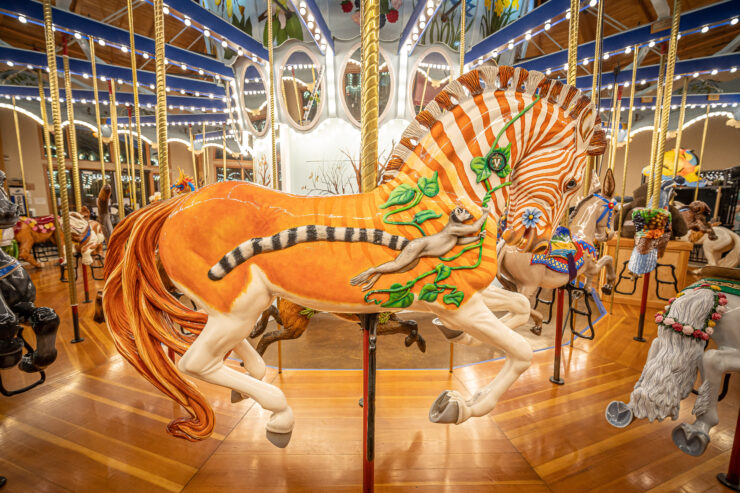
Quivering with anticipation like the animals they bestride, children grip the pole before them, some gently, some fiercely, some with moms or dads reassuringly behind. All at once, the carousel turns, and the animals, which have been straining to leap forward, do so. An electric organ, whose music tastes exactly like bubblegum, plays. Popcorn scents the air.
Children in the carousel’s outer ring of animals (which are mainly “standers,” in contrast to the inner circles of “jumpers,” which go up and down), strain to nab a ring from a dispenser that they pass once per rotation, barely within reach. Most are plastic, a few are brass. If they happen to snag the odd brass ring, they get a free ride. The concentrated glee of the children (even older ones) transmits, and you’re compelled to feel it as well.
Albany, Oregon’s Carousel: The Start
In 2002, when Albany, Oregon’s city center was deteriorating because outlying malls were siphoning business, resident Wendy Kirbey happened to visit similarly afflicted Missoula, Montana. It had used the construction of a carousel as a stirrup to hoist itself up.
Inspired – but knowing zero about carousels, grantsmanship, or entrepreneurship – by sheer will, she started in motion the Historic Carousel & Museum of Albany, which catalyzed a downtown revival.
Most carousel animals today are fiberglass, but the gold standard is animals hand-carved from basswood – profound works of art, some of them capturing the intimations of ligaments and veins in the manner of Michelangelo.

Aspiring to this, fortune’s fair wind led Kirbey to master-carver Jack Giles, who worked in the IT department of a nearby college. Self-taught, he had worked earlier for an aircraft design firm, carving aircraft wind-tunnel models accurate to the thousandth of an inch. He trained 57 volunteer carvers, most of whom had never even taken an art class, to carve carousel animals. (Think of it, 57 nearby folks with the capacity to acquire the extraordinary skills to carve carousel animals. How many people possess other extraordinary talents, untapped?)

Albany, Oregon’s Carousel: Now
Kirbey had to find engineers to create a rotating carousel mechanism from a pile of scavenged antique parts. This itself took ten years, involving the meticulous restoration of wooden gears and timeworn motors. She had to raise the funds, oversee the design, and consult on the construction of a striking building to house everything. And vastly more. She mustered the skills of a CEO.
The Historic Carousel & Museum of Albany opened in 2017. There are now 41 animals on the carousel, all carved in-house. The goal is to have 52, along with two chariots and some spares.

All animals, each sponsored and partially designed by a donor, have to incorporate an element of whimsy, e.g., a butterfly on a bear’s nose or a flamingo riding a leopard. None of the carvers works full-time. It currently takes five to seven volunteers working in their spare time about 1,500 hours to complete an animal, which takes up to 11 years. It takes up to a year-and-a-half to paint them, sometimes with eight coats of oil paint using “stippling,” painting with innumerable little dots in order to create shades, shadow, and texture. All so deliriously happy children can ride a hand-built carousel, as did we.
This surely is the manifestation of Albany’s reborn soul.
Albany’s Farmers Market
The Albany Farmers’ Market, which runs Saturday mornings, is an exaltation of dewy produce and artisanal fare. Among other items, we purchased homemade focaccia, a small-farm rack of lamb, dandelion greens, wild spinach, ravishing red currants, heritage tomatoes (more delicious than mortal tongues deserve), and sunchokes, all for the dinner we planned to cook in our rental’s kitchen, stocked with a commendable selection of cooking tools, cookware, condiments.

Albany Museums
Though small, Albany, Oregon’s museum-to-person coefficient is high. The Albany Regional Museum, housed in what was originally a dry goods store, gives historic witness. There are excellent exhibits, as one might anticipate. But clearly there’s an inner imp. Their temporary X-Files exhibit peers at Albany’s past through a morbid lens.
It describes a fellow who escaped the Oregon Hospital for the Insane (now the Oregon State Hospital) by burrowing through a brick wall and lowering himself with sheets. It describes a family of 13 that ate canned string beans infected with botulism, killing 12 of them. It describes a woman who died from drinking ginger ale purposely poisoned (by whom is debated). It describes aliens, monsters, and ghosts. It speaks to our inner ghoul. It’s edifying.
Thomas and Walter Monteith named Albany, Oregon (aka Hub City, because you can get anywhere from it) after Albany, New York, near their childhood hometown. They built Albany’s first frame house in 1848. It is still standing, with almost all of the original woodwork intact. It is now a museum, and stepping into it is a backflip in time.

All the walls in its day were covered in muslin and still are (though it’s not original), in order to keep sifting dirt, dust, and bugs from penetrating. Beds had chamber pots beneath. There were at least five layers of wallpaper, the original still visible in places. Its ghosts are spoken of with trepidation and pride.
Our Remarkably Nice Rental
The Howard Building was constructed in 1929 to house a newspaper, with living quarters on top for the Howard family. Before the building went up, a basement was dug and outfitted with printing machinery too cumbrous to install later. When the newspaper closed, the machinery was so heavy and indestructible, it was simply left to molder behind locked doors.
The McLain family has completely renovated the top floor, owners of Springhill Cellars Winery, with its windows even with the crowns of neighboring trees.
This was our handsome rental. Its 4,000 square feet contain a gas fireplace, three large bedrooms, two bathrooms, a feed-a-crowd dining room, a spiffy kitchen, and a capacious billiards room (where all hopes that life-experience had improved our game since college were dashed).
It is the style to which we wish to be accustomed. It’s the perfect headquarters for those visiting area wineries, a quick walk to all the cool stuff downtown.

Reveling in Restaurants and a Winsome Winery
We breakfasted at affable Margin Coffee, whose joe was just the pinball plunger our day required.
We lunched at Ba’s Vietnamese Comfort Food with an entry sign that proclaimed its embrace of all who are disenfranchised. They lit incense within, “a ritual of gratitude.” We ate a Pho-Wich, a banh mi with brisket and sliced meatballs with a jus of aromatic pho. Their shrimp-pork salad rolls were paradigmatic.

© Susan Greenberg
We dined at Sybaris, perhaps Albany’s haute cuisine flagship. Before entering, we were on tenterhooks. Would it be good? Once we entered, we were startled to see actual tenterhooks, formidable metal hooks (used years ago to hold drying fabric), holding up decorative slabs of wood. We interpreted this to mean they understood our concern, and we should have faith.
Rightly so. Their salmon was cooked au point (so difficult to do) with Choron sauce (a seldom-served tomato-spiked Béarnaise). It sat atop a crisped onion cake with perfect vegetables. We adored just-picked organic raspberries and strawberries at the apogee of ripeness, flavor grenades in a puddle of richly cultured Mexican crema, like subtle, liquid cheesecake.

Springhill Cellars Winery encompasses the family home and a quarter acre of vines (12 acres elsewhere). While admiring the far coast range, we tasted five wines, every one of which we liked, unusual for us. We particularly liked their three Pinot Noirs, a Rosé, and a 2014 Pinot Port style. We bought a 2017 Pinot with notes of Bing cherry and plum for our dinner.

A Stroll Downtown
Downtown, we browsed a homemade ice cream store, a fly-fishing store, a bead store, a live theater space, a first-run movie theater, numerous antique stores, abundant eateries, pubs, and clothing stores for natty dressers, among the usual lot you’d expect in an ascendant downtown. Too many towns are missing teeth, and it’s heartening to visit one with a full set, healthy, well-brushed.
The Historic Carousel & Museum of Albany has successfully become a downtown anchor. It has attracted businesses and people to downtown to revitalize its economy. Additionally, it has helped build community spirit and has become a hub for the city that rotates around it. It’s as though children on the carousel are a tuning fork and all of Albany is in sympathetic vibration.
One More Albany Restaurant and a Pub
Brick & Mortar serves portions to put paunches on plowmen. In this age of $20 cocktails, confit of Canadian swan, and ham from pigs fed wild bonbons (all of which we love), there are a few who see further into the Zeitgeist.
So it is with Lane Brown, who saw what many folks really want is big portions of simple, reasonably priced American chow cooked well. We had eggs Benedict anchored by fried chicken and an egg, spinach, bacon, tomato, and cream cheese scramble. We can’t conceive of all the Idaho farmland required to supply the potatoes for their aggregate hashbrown production.

Calapooia Brewing Company distills its own liquors, ferments its own beers. Its main area is an enormous, barnlike space with an attached barbershop (the shaggy beer-lover’s missing link rediscovered). We drank a terrific Hazy Shores IPA with citra hops and a house-brewed root beer. Six musicians up front jammed blues.

A River Runs Through It
Albany straddles the Willamette River, whose paddle-wheelers once connected it to the world. Now the river is used recreationally.
One of its tributaries is McDowell Creek. We drove to Majestic Falls on McDowell Creek, spotting its spume before we saw the waterfall itself.
Comparable to some of the falls in Rivendell (The Lord of the Rings), it conjures enchantment, forces beyond understanding, and time’s passage. A solvent for spiritual sclerosis, it is one of four falls along the creek, which has numerous swimming holes. We picnicked there on an overhanging platform on superb charcuterie with a bottle of Italian white from Albany’s Grazing Oregon.

The Final Crashing Culinary Chord
All our lovely market produce beseeched us to help them fulfill their destinies. To cook them well would be to honor them.
French gourmets affectionately say that their beloved cassoulet, filled with beans, is a “windy” food. The nickname for a sunchoke, tuber of a particular sunflower, is Fartichoke. American gourmets must be prepared to sacrifice for their art, no less so than the French.
We roasted the unpeeled sunchokes along with peeled shallots for about 45 minutes and then immersion-blended them in stock with a large dollop of heavy cream and a twist of salt. Of all the many soups who attend the theater, this is one worthy of the royal box. It gives proof that some royals are gasbags.

And More
Never ones to shun excess, we also made: Raw tomato-fresh mozzarella salad with basil leaves and grilled focaccia, Dandelion-greens-wild spinach-avocado salad with red currants, Armenian pilaf (sauteed shallots, small sauteed segments of spaghetti, basmati rice, cooked in stock), Grilled lamb chops marinated in olive oil, salt, and fresh rosemary, Blueberry pie with vanilla Häagen-Dazs. We drank the Springhill Cellars 2017 Pinot Noir.

© Susan Greenberg

Insomuch as most of the ingredients and the wine came from around Albany, this delicious dinner was our affectionate tribute to a soulful city. Wasn’t it Liza Minnelli who sang, “Life is a carousel, old chum, Come to the carousel”?
Thank you to the Albany Visitors Association for hosting us, and for providing the Featured Image of a zebra on the historic carousel in Albany, Oregon.
If You Go
- Albany is an easy 70-mile drive from Portland along I-5
- You can find visitor information at https://www.albanyvisitors.com/
- You can rent the historic loft we stayed in at https://www.vrbo.com/2989567
You might also enjoy:
- A Culinary Journey Through Slovenia (by David)
- A Step Back in Time: Pittock Mansion in Portland, Oregon
Read more of David & Susan Greenberg’s food and travel writing.

