
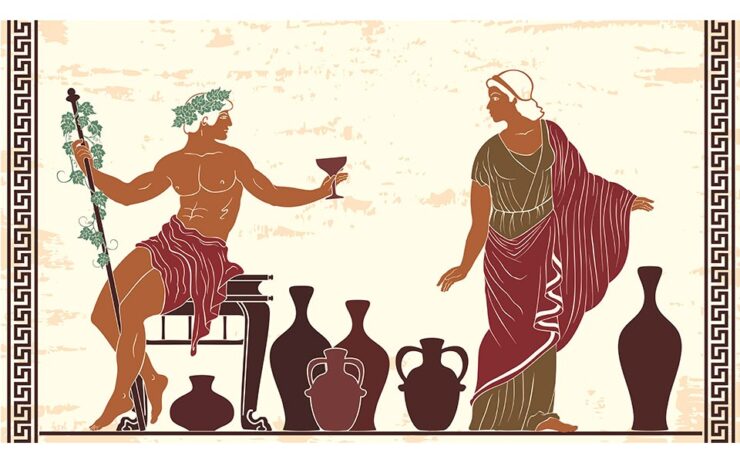
If you think Greek wine begins and ends with Retsina, you’ve clearly never crossed the Corinth Canal from Athens. But let’s start further back. Let’s start with Dionysus.
For the last 600 years of Greek history, the Greek god of wine, festivity, fertility, and folly seems to have been…no show, no go. Perhaps sipping quietly in Olympus while the Greek wine world struggled. Let me explain.
Where Was Dionysus?
Before my recent visit to the Peloponnese wine region, I didn’t understand the obstacles Greek wine has faced over the centuries. The Ottoman Occupation of Greece lasted about 400 years, until the Greek Revolution in 1821. The Ottomans systematically burned vineyards and shut down wine production. Where was Dionysus then?
Following that, the Phylloxera epidemic, two World Wars, and the Great Depression scarred the land and winemaking. Greece has also suffered many economic crises and a military junta, leaving vintners scrambling, scraping, and sometimes swapping their vines for olives and other crops. Greek wine, it seems, has suffered in the absence of its Greek wine god.
And now, finally, something is stirring. Dionysus, or at least his spirit, may be ready to step back onto the stage.

The Peloponnese Region
The Peloponnese region, in particular, feels like the right place for Dionysus to emerge. It’s a super easy place to visit, only an hour-plus drive from Athens. It’s the oldest wine region and the largest producer in the country. And hey, it has Ancient Olympia (home to the Olympic Games), Mycenae (Greece’s predecessor and home of King Agamemnon), Sparta (Remember “The 300” who fought off the Ancient Persians?), The Byzantines (Founders of the Eastern Roman Empire and Greek Orthodox Church), and Kalamata (you know, of the olive variety).
The history of wine here is also ancient, dating back at least 4,000 years. People wove wine into daily life, commerce, and celebration. The Peloponnese was a center of production, and Dionysus held forth proudly.
But as the centuries passed, vineyards were abandoned, destroyed, or forgotten. Greek wine became a shadow of its former self, and only the stubbornness of local families kept it alive. Modern Greek wine really only took shape about 60 years ago. Before that, Retsina, the pine resin-flavored wine, was the most well-known and mass-produced in Greece.
Check out the Wines of the Peloponnese website, which offers a comprehensive history of wine regions and grape growing.
Bring Back the Hero Grapes

Spyros Drouvas of Drouvas Winery is betting on the resurgence of indigenous grapes in the Peloponnese. “Bring back the Hero Grapes!” he exclaimed during our visit.
Which brings me to the dynamic and occasionally controversial topic of international versus indigenous grapes.
International grapes of the European pedigree, i.e., Vitis Vinifera, are well known, reliable, and cross-cultural, although somewhat homogeneous in their flavor profiles, irrespective of where they are grown. Think the varieties of South France, such as Cabernet Sauvignon, Merlot, Sauvignon Blanc, Chardonnay, Pinot Noir, Syrah, and Grenache. Many of the world’s winegrowing regions outside of Europe have grown them with varying levels of success over the last 50-60 years.
Cue the Imminent Return of Native Grapes? Perhaps
Indigenous or native grapes are on the rise in popularity in many places, including on the Peloponnese. This is due to increasing consumer interest in enjoying new flavors and wines with local and cultural identity and a sense of place. If you’re growing grapes, native varieties offer disease and drought resistance, an opportunity to feature regional uniqueness, and a marketing strategy to prompt consumer discovery.
In places like the Peloponnese, there is an intentional and pronounced shift from international to native grapes, or at least a desire to offer a diverse portfolio of wines, and it’s starting to play out with consumers. These white and red varieties – Assyrtiko, Agiorgitiko, Kidonitsa, Malagousia, Mavrodaphne, Malvasia, Moschofilero, Roditis, and Xinomavro – reflect the growing interest in native grapes and natural,terroir-focused wines. The Peloponnese PDO (Protected Denomination of Origin) has had these grapes for thousands of years and many of the varieties are enshrined in ancient Greek history. They can even be found in Homeric literature, such as the Iliad.
I’ve even heard there are restaurant wine lists in Athens entirely dedicated to native grapes. From a marketing perspective, native grapes offer a point of difference. The fact that Greek wines are value-priced is an additional bonus.
The Greek wine brand can benefit from all of this with some help, but from whom? Well… you know who.

Step Back in Time with These Wineries on the Peloponnese
Today, rows of vines are planted on the slopes of mountains in several regions, along with stone walls marking boundaries and terraces, lots of olive trees, and scatterings of goats and sheep for good measure. Everything appears functional and integrated.
The Peloponnese has a warm, inviting culture that feels modern and vibrant while still respecting its past. What these Peloponnese wineries have going for them is history and their related stories. Funny how “history” still has “story” sitting right in the middle of it.
Visit these regions, meet the people who are doing the work, and listen to their stories. They are pragmatic, knowledgeable, and passionate. Here are my recommendations for wineries to visit as you circumnavigate the Peloponnese, counterclockwise. Meet them, taste the wines, read their history, and share your experiences. Check the Winery Websites below for details.
Corinthia
Corinthia PGI (Protected Geographic Indication) is the northernmost wine region and closest to Athens. It is known for Agiorgitiko and large production Roditis. The vineyards exist between the urban and industrial sprawl of the City of Corinth and beautiful hillsides near Nemea, where most of the grapevines and wineries are located. Visit these wineries en route to Patras.
Giannikos Winery
The Giannikos Family founded the Giannikos Winery in 1896 near the ancient site of Mycenae. The family estate winery suffered a devastating fire in 1996 and was reestablished in Corinth. We met Michalis and the charming Giannikos Family at their home and winery, tasted in the cellars, and enjoyed a casual lunch afterward. All of the wines are single varietal and estate grown, and you’ll taste both indigenous and international grapes. The family is also estate-grown, and our lunch came from their kitchen. It’s a charming place and a must-visit. Please tell the family I sent you.

Semeli Estate Winery
Semeli Estate is a modern winery perched on top of a 1,800-foot hillside, and surrounded by vineyards and views that seem to go forever. The buildings are architecturally impressive, as is their approach to sustainability and conservation. Fortunately, Semeli Estate’s wines are well distributed, and you will likely find them in your local markets. The Semeli Experience includes tasting, dining, and 10 guest suites. We didn’t stay here overnight, but I have noted to myself to do so on my next visit.
Patras
Patras is Greece’s largest PDO (Protected Denomination of Origin) and is located in Northwest Peloponnese, near the city of Patras, which is mainly known for its port and carnival. The PDO is best known for dry white wines made from Roditis, and for sweet fortified wines such as Mavrodaphne. The region has diverse terrain, from coastal plains to mountainous areas up to 900 meters in elevation. Patras PDO is recognized for the volume and quality of its wines, especially Mavrodaphne, which has been produced since the mid-19th century. Visit these Wineries while in Patras.
Mega Spileo Estate Winery
Mega Spileo is a vineyard, winery, monastery on the pilgrimage routes, UNESCO World Heritage site, national park, and one of the most stunning vineyards and tasting room locations you will ever experience. It has the oldest patronage of any winery in Greece. Its roots trace back to 362 AD, and vineyards have been farmed here since the 15th Century, mostly for use by the monks who managed them. Ask to see the massive ancient “Angelis” wine barrel, all 12 tons of it.

Achaia Clauss, aka House of Clauss
Achaia Clauss is the oldest continuously operating winery in Greece, and is said to have established the modern wine industry when it was founded in 1861. It was once an entire community, with winery buildings, lodging for the vineyard and winery workers, schools, and churches, all built by Gustav Clauss, a Bavarian German, who visited and decided to make it his life’s work. I’d recommend spending several hours here, not only for wine tasting but also for the on-site exploration of the history of Greek wine. Learn about the founders, visit the living wine museums – Cooperage Museum and Imperial Cellar – to learn about the origins of “modern” winemaking, and see some of the most ancient wine barrels in the world. Tour the gardens, courtyards, and Greek Orthodox historical churches. This is an unforgettable must-do multi-sensory experience if you’re in the Patras area. And you will be treated like wine family.
Olympia
Olympia PGI is in western Peloponnese, only 75 minutes from Kato Rodini (where we stayed), outside of Patras. It is the birthplace of the Olympic Games, and it feels almost sacred. Ancient vineyards grow surrounded by myth and history. The area is best known for fresh whites and light reds. Vineyards benefit from a mild Mediterranean climate, ideal for crisp whites such as Roditis. You won’t find much mass production; rather, you’ll find multi-generational winemaking families.
Drouvas Winery
Visit Drouvas Winery. You won’t find a warmer, more genuine welcome than that from the Drouvas Family. The emphasis is on authenticity. They represent the landed agricultural families that have been working vineyards since the mid-1800s, with the namesake brand operating since 1960. You’ll be treated to a tasting with current owner and Grandfather Spyros or his granddaughter Loulia, and his wife Gioula will set your tasting table with mezze plates to pair. You’ll feel right at home and wonder why more wineries can’t duplicate this experience. The answer? It’s authentic, and you can’t reproduce that.

Monemvasia
Monemvasia-Malvasia is the southernmost PDO on the peninsula. It is a fortified village perched on its fortress rock, famously producing sweet Malvasia wines made from sun-dried grapes that are oxidatively aged. During the 12th Century, Venetian merchants traded and popularized sweet Malvasia wines all over Europe. Many consider it the most sought-after wine during the Middle Ages and the Renaissance. The fortress village of Monemvasia was founded in 583 AD during the Byzantine period, and is considered one of the oldest continuously inhabited towns in Europe.
Monemvasia Winery
Yiorgos Tsimbidi and Family established the Tsimbidi Monemvasia Winery in 1997, with the intention of reviving the ancient wine Monemvasia-Malvasia. Their efforts resulted in the establishment of the Monemvasia-Malvasia PDO. Today, daughters Marialena, Anastasia, and Andreas are running the show (don’t tell Yiorgos). Tours and tastings take you through an impressive barrel room and unique cellar. Everything is professionally run and a visit to the winery is a must when you’re in Monemvasia on the southern tip of the Peloponnese.
Nemea
Nemea is the crown jewel of the Peloponnese wine revival. The Agiorgitiko (Eye-Your-GHEET-IKO) reds here are world-class, and the variety is considered the flagship grape of Greece. Wineries are located on the rolling hills of what most would consider a classically beautiful wine region. The Peloponnese isn’t just reclaiming its wine heritage — it’s doing so with a quiet, determined pride that no Greek god could replicate. Visit these wineries in Nafplio area.

Domaine Skouras
George Skouras studied enology in France before founding Domaine Skouras winery in 1986. They were among the first in modern Greece to focus on high-quality Moschofilero and Agiorgitiko, bringing global attention to local grapes. Try the “Greek Goddess” Moschofilero, which is floral with crisp acidity, and the name is fun to say (MO-SHOW-FEE-LERO). The winery deployed a clever strategy of introducing native grapes blended with international grapes. “Mega Oenos” is a blend of Agiorgitiko and Cabernet Sauvignon. Cabernet was the bait that drew wine aficionados’ interest in also trying Agiorgitiko. The ultra-modern facilities include a 1,000-barrel cellar that you’ll tour, which is as impressive as any, anywhere. The wines are stellar and you’ll want to linger over a bottle. Be sure to ask about catered lunches when you make your reservation.
Papantonis Winery
Papantonis Winery was established in 1992 (vineyards acquired in 1979) by siblings Antonis and Kallie Papantonis, near Argos. The winery built its reputation on its early focus on quality red Agiorgitiko and white Roditis-Chardonnay blends. Antonis has an economics degree from Kaplan University in Iowa. I couldn’t help but ask why someone who understands economics would ever get into the wine business. His friend George, a colorful character, supplied the answer “Why not?”
The winery became the first to produce high-quality sweet wine from Agiorgitiko in 2002. It is deeply rooted in its philosophy of “nothing in excess” and “moderation is best,” reflected in both wine style and personalized hospitality. Visiting Antonis, and hopefully his pal George, is a unique experience and peek into the fundamentals of small Greek wineries.
Divine Intervention — or Not
By the time you leave the Peloponnese, you will understand something important. Dionysus might be distracted or bemused, but the people are determined to succeed, with or without divine intervention.
Winemakers intended the experiment with international grapes to familiarize consumers in the 1970s and 1980s with Greek wines, but it lost steam over time. However, it has led to where we are today – the shift to and resurgence of native grapes, which our favorite Greek Wine God should easily be able to support.
The wine industry on the Peloponnese has learned resilience. It has learned identity. And it is ready, at last, to be noticed, appreciated, and celebrated.
So, can Peloponnese and Greek wine not only trend but have their moment in the sun? Time, buyers, and consumer palates will tell. Until then, gods may come and go, but the land and families remain, stubborn and quietly alive, waiting for those willing to listen and drink deeply. Dionysus, we’re counting on your support.
If You Go
For more information about wine on the Peloponnese, try these sources:
You might also enjoy:
- Barnacles and Albariño: Rías Baixas Wines and Galician Gastronomy
- The Tastes of Baja California, Mexico’s Valle de Guadalupe
Subscribe to Carl Giavanti’s international Winemaker Interview series Wine Characters for a fresh take on the people behind the bottle.
