
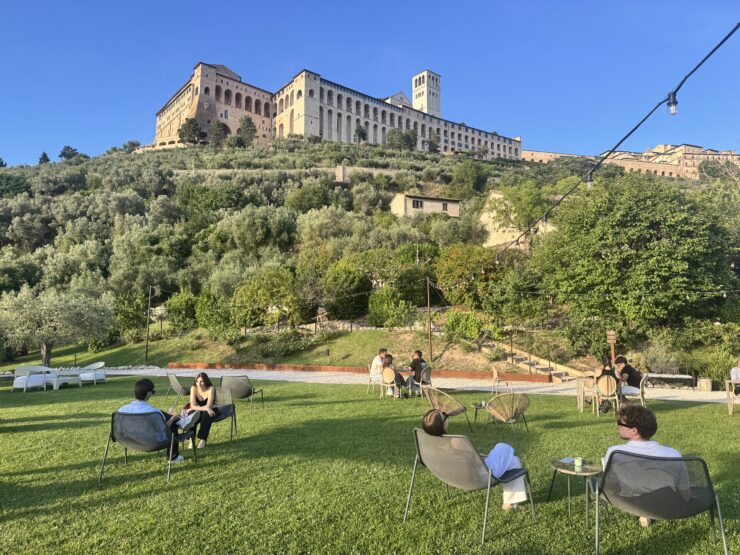
Ask a traveler to describe their favorite view, and it’ll probably involve standing on a peak, summit, or cliff edge surveying the landscape below. For a medieval pilgrim visiting Assisi, the opposite was true.
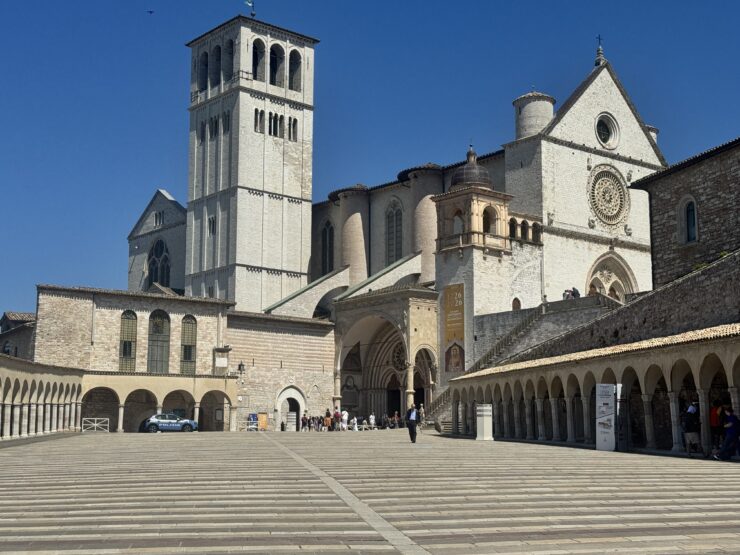
The Basilica of St. Francis dominates Assisi’s skyline from the slopes of Mount Subasio, a view that grows more imposing the closer you get. Modern visitors to Assisi, alongside a steady stream of pilgrims, find themselves craning their necks as the city’s pale stone walls and basilica gradually fill the horizon, marking the end of their journey. The sheer size of the basilica continues to inspire awe, even for those not on a religious journey.
© Phil Thomas
The city remains deeply spiritual, as befits a place that has welcomed pilgrims for centuries. Tour groups led by sprightly nuns pause to recite collective prayers while, a few streets away, less devout visitors linger over late-afternoon spritzes beneath café parasols providing respite from the late spring sun.
Eight hundred years after St. Francis’s death, pilgrims still arrive seeking spiritual guidance. Others come for rather more earthly pleasures. These include memorable meals, slower rhythms and a closer connection to the Umbrian countryside. Spend a few days here, and the distinction begins to markedly blur. Visiting Assisi remains an exercise in calm.
A Six-Century Tradition
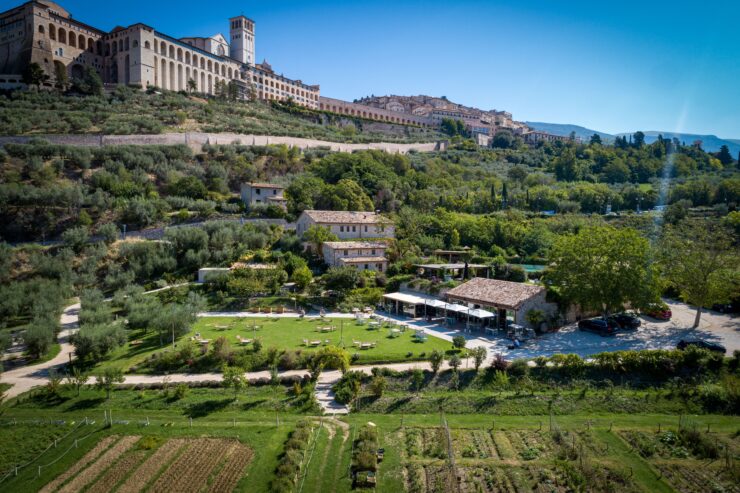
Borgo Antichi Orti sits in the foothills beneath Assisi, where the Basilica of St. Francis dominates the skyline. Opened as a hotel in 2019 by former Italy and Internazionale defender Andrea Ranocchia, its history stretches back much further, occupying the site of a Benedictine monastery founded in 1448.
The Benedictines built communities around the principles of ora et labora – work and prayer. Hospitality, self-sufficiency, and careful stewardship of the land were everyday practice rather than fashionable aspirations. Nearly six centuries later, much of that philosophy still shapes life here.
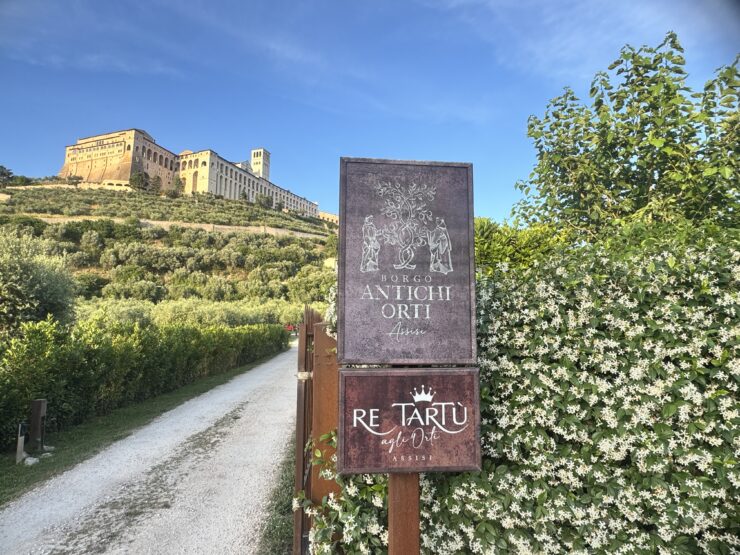
Former guest cells have become bedrooms. Sixteenth-century wooden doors have been repurposed as headboards and bedside tables. The old animal trough is now the swimming pool, while the gardens remain as productive as in the medieval era, supplying herbs, vegetables, and fruit that appear in everything from cocktails and cookery classes to massage oils.
The gardens are divided into four sections reflecting the elements, with wild fennel, marjoram, pineapple sage, mint, and chives growing alongside onions, pumpkins, aubergines, and apricot trees. Little goes to waste. Residents from Milan and Florence rent vegetable plots, with seasonal harvests delivered throughout the year, a modern interpretation of the monastery’s long tradition of sharing its land with the surrounding community.
There are contemporary touches, of course. Sunset yoga takes place overlooking Assisi’s walls (few classes can rival the view during a downward dog). Vegetarian cooking classes, year-round truffle hunts, and seasonal harvest experiences invite guests to engage with the landscape rather than simply admire it.
The Percorsi Verdi – “green routes” – connect the land with the surrounding towns via well-marked, shaded pathways. A fifteen-minute uphill walk ends the journey for those visiting Assisi itself. With every step, the basilica grows larger, a reminder that visitors have been making this same journey for centuries.
How To Recalibrate Your Palate
Everywhere around Assisi, olive trees stitch together the hillsides, their silvery leaves catching the Umbrian sunshine. This year’s flush of white blossom promises a generous harvest. This makes it an apt moment to visit Olio Decimi, an olive oil producer that has quietly built a reputation for challenging convention in one of Italy’s oldest agricultural traditions.
Until now, my understanding of olive oil had extended little beyond buying a bottle labeled “extra virgin.” At Decimi, that ignorance is quickly exposed. Like wine, olive oil has its own terroir. Different varieties and blends produce distinct aromas, textures, and flavors.
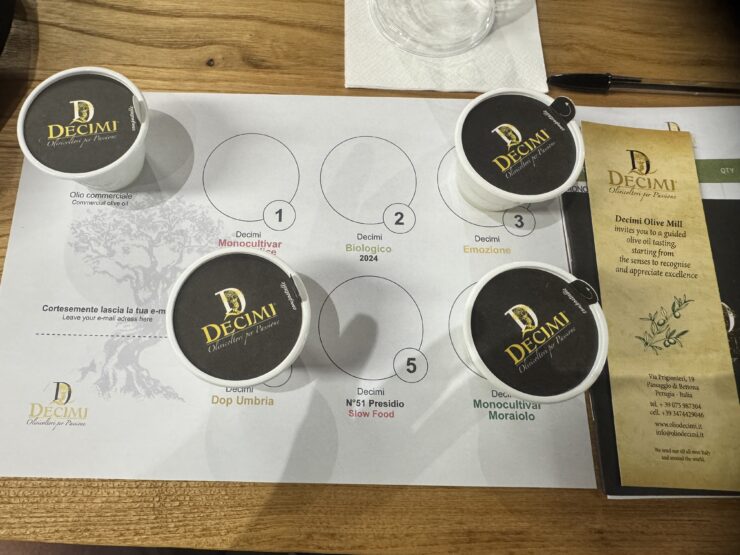
The tasting begins with a supermarket oil. Warmed between my hands and inhaled, it smells reassuringly familiar. Then come Decimi’s own oils. Suddenly there are notes of freshly cut grass, wild herbs, and summer flowers, followed by a peppery kick at the back of the throat and a surprisingly clean finish that leaves my mouth dry rather than greasy.
I return to the supermarket cup. It now smells of almost nothing. My palate, it seems, has been quietly recalibrated.
Established only in 2004, Decimi lacks the centuries-old family history common across Umbria’s olive industry. Rather than seeing that as a disadvantage, the team views it as freedom. They are able to sacrifice quantity for quality, experiment with blends, and question accepted wisdom. The creativity extends to producing nut and pistachio spreads containing their oil, providing a smoothness of flavor I’ve never experienced.
“Sometimes tradition is our heartbreak,” Romina Decimi, the co-owner, explains.
It’s a sentiment that could equally describe modern Assisi, where preserving the past rarely means being trapped by it.
Produce That Speaks For Itself
Dinner is served in the monastery’s former stables, now home to Re-Tartu restaurant. It’s a surprisingly intimate setting, punctuated only by the observation that the upstairs rooms are haunted.
“Nothing to worry about,” explains Head Chef Andrea Funghi. “We only have friendly ghosts here.”
Perhaps it’s the scent from the kitchen that keeps them here.
If Borgo Antichi Orti’s gardens explain the hotel’s philosophy, the kitchen demonstrates it in practice. Much of what appears on the plate has traveled little further than I have from my room. Herbs clipped from the garden perfume cocktails and sauces, while the surrounding Umbrian countryside provides vegetables, olive oil, and, most famously, truffles.
Like my previous understanding of olive oil, my knowledge of truffles proves embarrassingly limited. I’d long assumed they were an occasional luxury, shaved sparingly over pasta in expensive city restaurants. Instead, they’re a year-round ingredient here, changing with the seasons and appearing with surprising versatility.
Over dinner, they lend depth rather than dominance. They enrich a perfectly cooked steak, bringing an earthy richness to scallops and, most unexpectedly, finding their way into ice cream, where their savory intensity pairs with creamy sweetness and somehow makes perfect sense. It’s inventive without ever feeling contrived. This is the sort of cooking that relies on exceptional ingredients and a simplicity that the former residents of the monastery would appreciate.
The same philosophy runs through the rest of the menu. Local produce is allowed to speak for itself, whether that’s olive oil poured generously over vegetables, herbs picked only hours earlier, or Umbrian specialties prepared with quiet confidence rather than unnecessary embellishment.
As darkness settles beneath Assisi’s illuminated walls, it’s hard not to think that visitors have been gathering to eat, rest, and share stories on this hillside for centuries. While modern wellness tourism often focuses on what to add to life, Assisi’s traditions are rooted in subtraction. Simplicity of ingredients, fewer interventions, closer ties to the land, and a greater appreciation for what is already there.
If You Go
Visiting Assisi is relatively straightforward. The small airport at Perugia – named after St Francis, obviously – is closest to Assisi. It is located a 15-minute drive away from the city. Flights arrive from a small number of European cities, including London, Barcelona, and Krakow.
Rooms at Borgo Antichi Orti start from $165 per night. Transfers from Perugia airport or Assisi station can be arranged upon request.
Most intercontinental travelers arrive in Rome. From here, visiting Assisi is an easy two-hour ride away. Florence is two and a half hours away.
Multiple-day tours operate. Book tickets in advance on the Trenitalia website or app. The station is located a couple of miles from the city, with a bus connecting to the upper city.
Viator also offers day tours, including coach transfers, to Assisi from Rome and Florence.
You May Also Enjoy Reading
Where the Buffalo Roam: A Visit to Italy’s Premier Mozzarella Dairy
Abruzzo: Italy’s Best Kept Secret
Read more from Phil at: Someone Else’s Country.
