
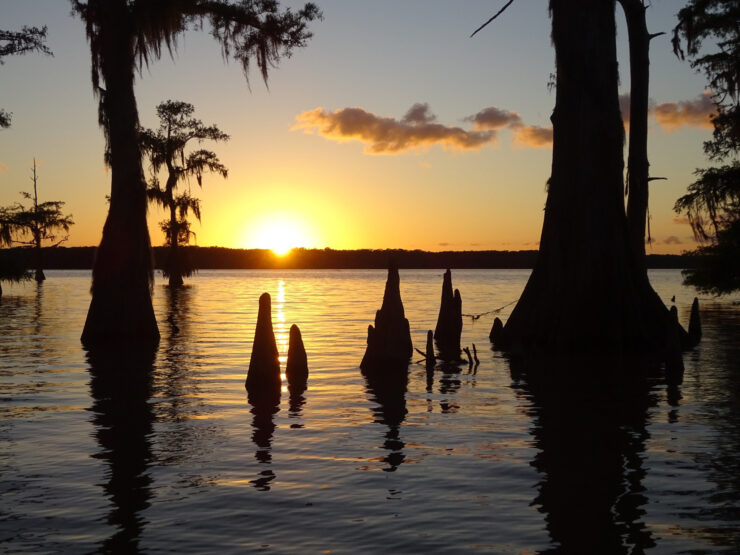
A veiled plantation ghost, a legendary pirate, and the first on-screen Tarzan all share the same watery stage along the Atchafalaya River on Louisiana’s Cajun Coast.
Step onto a flat-bottomed boat with John Burke, better known as Captain Caviar, and those stories become woven together along with the calls of herons, the slap of water against cypress knees, and the low glide of alligators through the Atchafalaya Swamp.
Over the course of three unhurried hours, this self-described “amateur historian” turns a tangle of bayous into a living, laughing archive of folklore, film lore, and natural history.

He also adds amateur ichthyologist, herpetologist, entomologist, ornithologist, meteorologist, arborist, and entertainer to the list, not to mention that he is a licensed U.S. Coast Guard captain who has been traversing the Cajun bayous for more than 50 years.
Burke describes his swamp tour as “the truths and tales of Saint Mary Parish.” It has long been known as south-central Louisiana’s “most ghostly” parish.
Atchafalaya Basin: The Largest River Swamp in the U.S.

©Debbra Dunning Brouillette
Atchafalaya (in case you were wondering) is a combination of two Choctaw words, “hacha” and “falaya,” meaning “long river.” The Atchafalaya Basin is the largest swampy wetland in the United States. It’s where the Atchafalaya River and the Gulf of Mexico meet.
Captain Caviar put on his “amateur historian” hat to fill us in a bit more. “It’s also known as the Atchafalaya National Heritage Area. Originally, the Atchafalaya River had an upper and a lower channel. Around 1930, the U.S Army Corps of Engineers cut off our Channel. They built a levee system around the Atchafalaya Basin, enclosing almost a million acres of wilderness. So this morning we’re going to go out and see just a little portion of it.”
The Ghost of Idlewild Plantation
Even before we boarded the boat, Captain Caviar regaled us with the story of Idlewild Plantation, located near the property where we gathered for the tour. Standing in the shade of a massive Southern live oak tree, estimated to be nearly 500 years old, he began explaining the history of the former dairy plantation, built in 1850.

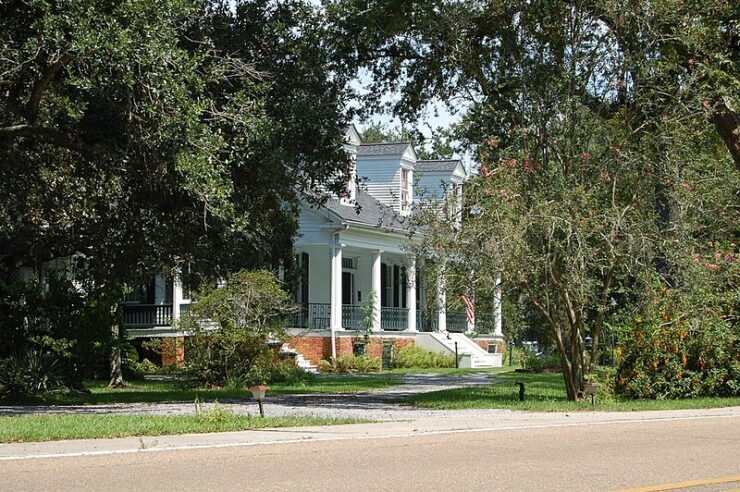
Idlewild served as both a Civil War command post and, later, a temporary hospital. French nuns cared for sick, wounded, and dying soldiers there. During the yellow fever epidemic, it was used again. Since 1982, it has been listed on the National Register of Historic Places.
“When we moved into this antebellum home, we were just the third family to own it,” Burke began. “My dad, who was a medical doctor, said he didn’t believe in the spiritual world, as he’d seen far too many people die right in front of him. He’d never seen anyone rise to heaven, and he’d never seen anyone pass sideways to purgatory. But after living in that house for all those decades, he began to believe in the spiritual world. His medical mind was changed because some of those spirits were living right there in that house with him.”
The Ghosts of Morgan City: Captured on Camera at Idlewild
In 2019, a team of paranormal experts visited Morgan City to investigate several cases of supernatural activity, including at Idlewild. Episode 3, “The Blue Shirt,” from the television show The Ghosts of Morgan City, was filmed at the plantation and first aired on the Travel Channel. “A full-bodied apparition was captured on camera, which you can see for yourself on YouTube,” he said. “We think the ghost was one of the nurses working the yellow fever epidemic.”
Here’s a clip of the “Full-Bodied Apparition CAUGHT on Camera | Ghosts of Morgan City | Travel Channel” from YouTube:
(Watch the entire episode free on Tubi.)
Jean Lafitte and the Curse of Pirate Island
Legendary pirate Jean Lafitte also navigated these waters, according to Captain Caviar. Some believe he buried treasure, including gold coins and jewelry, somewhere in the Louisiana bayous.

As we approached what is now known as Pirate Island, Burke slowed the boat nearly to a stop. “Lafitte sailed away from that island, only to go around the corner in the Atchafalaya River where he parked his ship,” he said. “That night, he sneaked back and murdered the comrades who helped him bury the treasure, so nobody would know where it was, except for him. Thus, the saying, ‘Never trust a pirate.’”
Though the mystery of Lafitte’s treasure endures, ghostly cries and noises have also been reported on Pirate’s Island and other parts of the Atchafalaya Basin. These stories were explored in Episode #4 of The Ghosts of Morgan City, titled “Pirate Island.” (Available to watch free on Tubi.)
Tarzan of the Apes: When Hollywood Came to the Swamp

As we ventured deeper into the swamp, we reached an area used in 1917 to film scenes for Tarzan of the Apes, the first Tarzan movie, released in 1918, based on Edgar Rice Burroughs’ books. Forty-nine more Tarzan movies would follow.
“Our Louisiana swamps served as a stand-in for the African jungle,” Burke told us. “Although eight acrobats were hired to play apes, in costumes made from goat skins and elaborate masks, real monkeys were brought in, too, and many were left behind.”
The Rougarou: Louisiana’s Swamp Werewolf
Children growing up in southern Louisiana are often warned not by the boogeyman but by the Rougarou. The werewolf-like creature said to roam the swamps at night will come after them if they don’t behave.

©Debbra Dunning Brouillette
Locals tell stories of eerie howls and glowing eyes in the darkness, and Captain Caviar, with a knowing twinkle in his eye, added his own flourish to the legend. “When they let chimps out to film the first Tarzan movie,” he said, “the legend is that the ones who weren’t recaptured bred with wolves—and that’s how the Rougarou came about.”
TV Shows Filmed in the Atchafalaya Swamp
Besides The Ghosts of Morgan City, two episodes of Swamp Mysteries with Troy Landry were filmed here for the History Channel. Members of the Duck Dynasty family also visited a few years ago to film a Duck Family Treasure episode with Captain Caviar, exploring the ghost stories surrounding Idlewild.
Captain Caviar has even been featured internationally. Roadtrip Amerika Season 2 included “Captain Caviar in the Atchafalaya,” which aired in Germany and Austria in 2023 and 2024.
Reality TV has also made its way to the Atchafalaya Swamp. Naked and Afraid XL, Season 7. filmed on Middle Island, a remote 3-mile-long location within the swamp.
The Living Landscape of the Atchafalaya Basin


“I get asked all the time about the wildlife we have here in the Atchafalaya Basin,” said Captain Caviar. “While we may have a lot of alligators, we also have many other critters. They can include raccoons, possums, beavers, muskrats, armadillos, river otters, turtles, snakes, and nutria, also called river rats.”
During our three-hour tour, we didn’t spot any of these, but several egrets and herons stood watch, ready to scoop fish from the shallow waters of the bayou. Captain Caviar pointed out an eagle’s nest at the top of a cypress tree, used year after year by the same pair.
In 2022, the BayouWildTV.com crew joined Captain Caviar for a swamp tour to learn about the area’s bald eagle population. Watch the full episode, “Eagles of the Cajun Coast,” on YouTube.
Spanish Moss: It’s Not Spanish, and It’s Not Moss

We also benefited from Burke’s knowledge of plant life in the swamp, starting with Spanish moss, which hangs so beautifully from the bald cypress and live oak trees throughout the swamp.
“Spanish moss isn’t Spanish, and it’s not moss,” he told us. “It’s actually a flowering bromeliad that gets nutrients from the moisture in the air. It doesn’t take nutrients from the tree, isn’t a parasite, and won’t kill it, but it can grow thick enough to slow down the growth.”
“Henry Ford used it for cushioning in the Model A, and it was also used in early mattresses. That’s where the saying ‘Don’t let the bedbugs bite’ comes from—because all the little bugs and critters living in the moss were sewn right into your mattress.”
Water Hyacinth: Beauty with a Cost

©Debbra Dunning Brouillette

Water hyacinth, a floating plant native to South America, carpeted the bayou in some areas. During the Japanese exhibit at the 1884 World’s Fair in New Orleans, it was first introduced to South Louisiana.
Captain Caviar pulled one from the water to show us its long root system. “It’s a filtering plant that floats wherever the wind and current take it,” he said. “During the growing season, it can double in size every eight days. Wildlife and fisheries have to spray it with herbicide—otherwise it would completely clog the waterways.”
You May Also Enjoy Reading
The Making of Captain Caviar
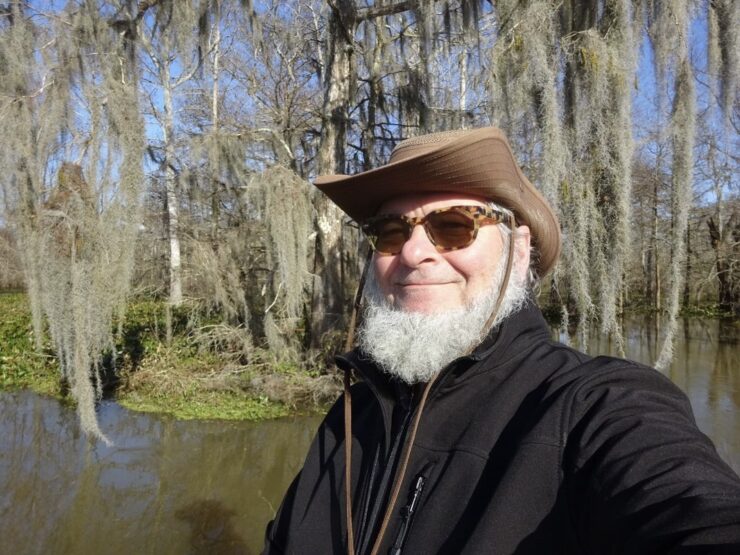
Burke didn’t earn the nickname Captain Caviar by chance. Before he ever piloted a tour boat into the Atchafalaya, he spent 30 years, from 1985-2016, harvesting roe from the choupique (pronounced “shoe-pick”)—also known as bowfin—a native Louisiana fish whose eggs closely resemble traditional European caviar.
His Louisiana Caviar Company received a major boost after an early sales call to Emeril Lagasse, then executive chef at Commander’s Palace in New Orleans. The product has remained on the menu there ever since.
In 2016, he sold the business to Emeril’s wife, Alden Lagasse, and two other partners. They continue to market the product as CAJUN CAVIAR®. The Malossol-style delicacy cured with minimal salt to preserve the roe’s natural flavor and texture.
That same year, Burke purchased Cajun Jack’s and renamed it Captain Caviar Swamp Tours.
A Taste of the Swamp: Caviar, Anyone?

©Debbra Dunning Brouillette
As we prepared to leave, our minds swirling with stories of the bayou, Captain Caviar revealed a final surprise. “Just have a seat at the picnic table,” he said. “I’ll be right back.”
He returned with crackers, cream cheese, smoked salmon, and a container of his BonVie Bowfin Caviar. He spread cream cheese on crackers and added a portion of smoked salmon. Then, he topped each with a spoonful of the briny black roe that has been a significant part of his life for decades.
It was the perfect way to end our time with Captain Caviar and the Atchafalaya swampland—a place he knows intimately and introduces to his guests with both humor and reverence.
If You Go

Captain Caviar’s Swamp Tours accommodate small groups of six or fewer. Passengers explore the Atchafalaya River and winding bayous one-on-one with Captain Caviar aboard the Miss S. A 150-horsepower engine powers the 20-foot flat-bottom aluminum boat with a canopy. Call or text John Burke (Captain Caviar) at 985-992-5383 to book a three-hour tour. The location address is 112 Main Street, Patterson, La 70392. The drive from New Orleans is approximately 1.5 hours, and from Lafayette, 1 hour.
Visit the Cajun Coast website to learn more about other activities you may enjoy, as well as where to eat and stay.
Featured Image: Courtesy of John Burke/Captain Caviar
Read more from Debbra at Tropical Travel Girl
