
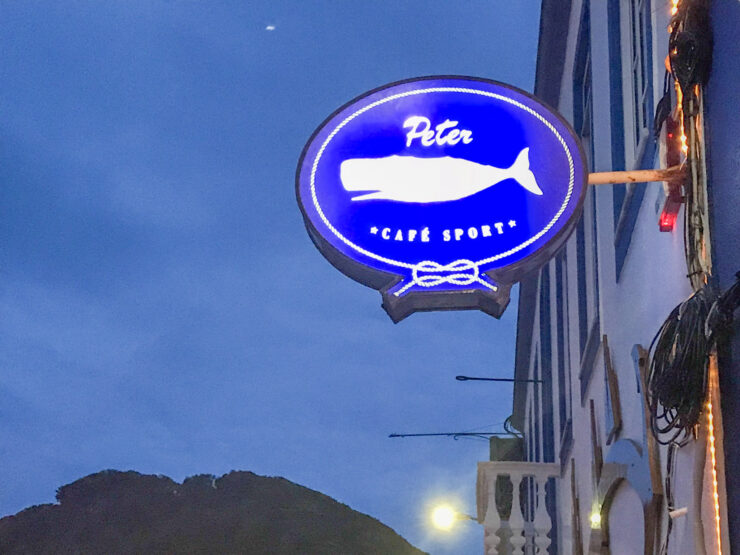
It’s the most famous sailors’ bar in the world. From behind the hundred-year-old thick wooden bar, the bartender pours gin drinks by the dozen. Inside Peter Café Sport, ships’ flags from around the world hang on the walls. Plates of hearty food flow out of the kitchen and onto tiny tables. People wait at the door, hoping to find a place to sit and take in a bit of the excitement and fun. It’s Saturday night, and you don’t want to be left out.

Sailors with their tanned, lined faces, hair crunchy with saltwater, wearing brightly colored windbreakers tough enough to withstand storms on the open ocean, stand out from the tourists. Tourists in their t-shirts and shorts, backpacks slung over their shoulders, walk by and stop in, curious. The locals, well, they just come by for a drink and food.

A Sailors’ Community
Peter Café Sport sits midway across the Atlantic on Faial Island in Portugal’s Azores Islands. It has served as a community for more than 100 years where tall ship sailors can leave or pick up letters and packages, find friendship and information, and enjoy a drink of Peter’s handcrafted gin. Made popular by the former British inhabitants working in the submarine cable industry on Faial, Peter’s is famous for its gin and tonics.

Horta, the main harbor of the Azores Islands, is the fourth most visited marina in the world and the primary stop for yachts crossing the Atlantic. A common phrase among yachtsmen says, “If you sail to Horta and you don’t visit Peter’s, you haven’t actually been to Horta.”

Scrimshaw Museum
I first heard about Café Sport from a tall ship sailor last year. Intrigued, I traveled 4,766 miles to see this vibrant bar and restaurant in the colorful port of Horta. I introduce myself to José Henrique Azevedo, Peter’s son and third-generation owner of the café, and ask if he has time to talk. He has kind eyes, a graying beard, and a gentle smile.
Looking for a place to chat, we climb the stairs to the Scrimshaw Museum above the bar. A source of pride and joy for José, the museum also serves as a repository of records, newspaper clippings, correspondence, and photos. And it’s here that the café’s history comes to life.

Poste Restante
The café first opened its doors on Christmas Day in 1918. Enrique Azevedo, an athletic man, named the bar “Café Sport” because he loved sports. Soccer, or “football,” was in its infancy then. At the time, Horta was the hub for companies laying transatlantic cables for communication. It was also an important stopover for whaling ships. “All this put our small island on the map,” says José.
During World War II, Enrique’s son, José, got the nickname “Peter” from a British officer. The officer said that José reminded him of his own son, Peter. The name stuck, and soon the café was called Peter Café Sport.
The café became a poste restante for sailors passing through, holding their letters and packages. José says, “We became the post office for the Atlantic because we were open from eight in the morning ‘til late at night and during the holidays.” Even in this age of internet, text messages, and instant communication, tall ship sailors still use Peter Café Sport as a “post office.”

Helping Sailors in Need
In the early days, Enrique would row out to arriving ships offering help with parts, access to a medical doctor, and, of course, an invitation to Café Sport for food and drink. Often, sailors would arrive without having showered for weeks. When other restaurants didn’t want their business, Enrique would welcome them, feed them, and tell them where they could find a cheap shower down the street.
Peter Café Sport built a reputation for helping sailors in need. The sailors would write about it and tell other ships. José shared a story from several years ago about a ship’s captain who was preparing to sail early the next morning. José asked the captain if there was anything he needed. “To tell you the truth,” he replied, “I could really use a pillow. I forgot mine, and it’s been so uncomfortable sleeping.”
But it was Sunday, and all the stores in Horta were closed. True to the philosophy of helping and caring, José headed home to ask his mother for a pillow. She found an extra one, and José brought it back to the grateful captain.
We return downstairs, where José shows me two wooden trays of letters and packages waiting for sailors to claim them. Deliveries and pickups are entered manually in an old-fashioned spiral notebook log.

©Pam Baker
Suddenly, a small band of sailors arrives, asking for mail. Excited and curious, I get up to see what’s happening. José asks the first sailor in line for her name, a young woman with sun-bleached blonde hair and pink cheeks. He fishes out a bright blue package and asks her to sign the log as she claims her prize. Delighted and thankful, she walks away.

An Act of Kindness
Before I leave, José has one more thing to show me.
Seventeen years ago, an older woman, her daughter, and three grandsons came to the Café Sport looking for information. The older woman’s husband, a senior British Naval officer, was stationed in the Azores during World War II. A tragic accident occurred at the military base on nearby Terceira Island when the officer’s plane crashed shortly after takeoff, and he died.
Fifty years after the war ended, the British government unsealed its records, allowing the family to learn more about what their loved one was working on during the war. They first went to Terceira looking for any information about him – a newspaper, a picture, anyone who could remember him – but they came away empty-handed.
Then they came to Faial. When they stopped at Café Sport, their guide asked José if he had heard of a man called Viscount Colville of Culross.
José tells me, “I could have turned her away because it happened before I was born. Instead, I asked her to return in half an hour.”
He went upstairs to the records that he, his father, and grandfather had kept for decades. Remembering his father’s discharge papers from the time he had spent in the British navy, preserved in a plastic sheet in a three-ring binder, he found a letter dated September 3, 1944. The Viscount Colville of Culross, Peter’s commanding officer, signed the discharge paper. The Viscount was also the British officer who nicknamed Jose Azevedo “Peter.”
José provided the grateful family with a photocopy of the letter, proof of their husband, father, and grandfather’s time on Horta, and a connection to this place of community here in the mid-Atlantic.

A Special Place in the Azores
If you go to the Azores, you must visit Peter Café Sport in Horta. Please tell José hello for me. And be sure to order a gin and tonic. Or better yet, try the Gin do Mar. The drink, invented by José in 2000, is a combination of gin with passion fruit liqueur. In Portuguese, passion fruit is called “maracuja,” and “mar” means the sea. It’s also the ultimate expression of this timeless place of community, a place worth traveling across the world to visit.

If You Go
Azores Airlines offers direct flights from Lisbon, Portugal, to Horta Airport. Nearby Sao Miguel and Terceira receive international flights operated by Azores Airlines and other airlines. Then take a domestic flight to Horta Airport.
To explore more of Faial, rental cars are available at the Horta Airport. Availability is limited, so be sure to reserve a car in advance, especially during peak season. However, if you’re only planning to explore Horta, the town is very walkable and easily reached via taxi.
For more on planning your trip to Faial, visit Discover Faial.
Azoris Faial Garden Resort Hotel is a few short blocks from Peter Café Sport and the town center. Its Olympic-sized pool overlooks the popular Horta Marina. Room rates include breakfast.
You May Also Enjoy Reading:
9 Camera-ready Vistas for Wining and Dining in Porto, Portugal
Discovering the Ultimate Kid-Friendly Douro Valley
Read more about Pam’s adventures at PamandGaryBaker.com
