
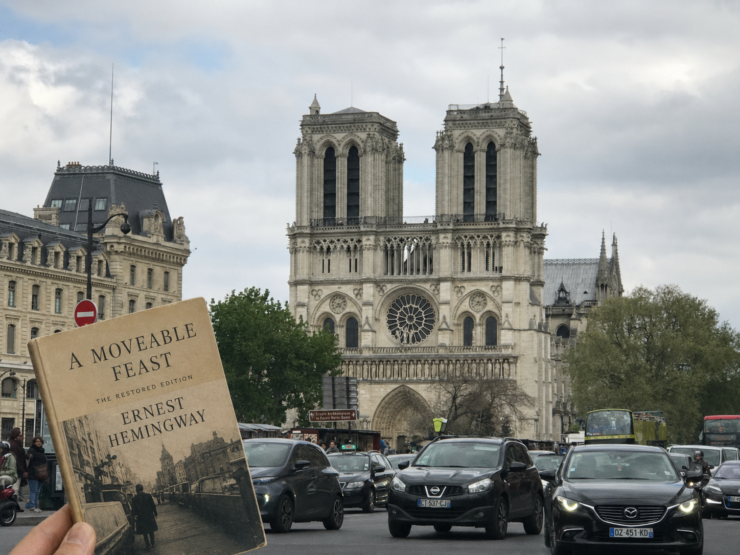
I went to Paris because I love Ernest Hemingway.
To me, Papa is not a myth; he’s a living entity. I love the writer who learned discipline through hunger. Who cut language to the bone because life had already taken enough. Hemingway believed clarity was an act of respect, and restraint a form of strength. I found him by accident, during my teen years, and I haven’t let go of him since. His prose speaks to me in a way that no other writer has ever reached me the way his words do.
I packed light. Clothes I could walk in. A good pair of shoes. A notebook I didn’t pressure myself to fill. And A Moveable Feast, soft at the spine, already carrying the weight of other journeys. Paris was a city I first met through his sentences, long before I ever arrived.
“If you are lucky enough to have lived in Paris as a young man, then wherever you go for the rest of your life, it stays with you.”
Hemingway moved to Paris in 1921 with his wife, Hadley, intending to work as a foreign correspondent for the Toronto Daily Star and to write. What he found instead was a decade that would later be mythologized into legend. A rare moment when writers and artists constantly crossed paths, fueled by ideas, alcohol, rivalry, admiration, and ego.
He met, drank with, loved, and loathed people like Gertrude Stein, James Joyce, Ezra Pound, F. Scott Fitzgerald, Joan Miró, and even Pablo Picasso. Whether the stories later told by the expats were fact or imagination hardly matters anymore. Paris became the container for it all.
During that decade, Hemingway and Hadley left Paris only briefly in 1923 so their son could be born in North America. It was here that Hemingway decided to move beyond short stories and attempt a novel after reading Fitzgerald’s manuscript of The Great Gatsby. His first novel, The Sun Also Rises, was written in Paris in 1926. By 1927, it had been published; the marriage was over, and Hemingway was remarried. A year later, he left Paris for Key West.
But Paris never left him.
That is the Paris I wanted to walk through. Not the monuments. I wanted the places that made the man who would become the voice of a generation.
The city is known for romance, fashion, and, of course, monuments that insist you look up. But the Paris Hemingway loved doesn’t ask for awe. It asks for attention.
I carried A Moveable Feast like a private map, not to landmarks, but to states of mind. I wanted to get into his mind, to feel him. Cafés where no one rushed me. Streets that didn’t explain themselves. A river that reminded me how many lives had passed through without needing proof they were there.
“We ate well and cheaply and drank well and cheaply and slept well and warm together and loved each other.”
Most mornings began in Saint-Germain-des-Prés, before the city put on its confidence. Coffee first. Book open. One page, maybe two. Hemingway wrote about hunger, and Paris still understands it. Not the hunger sold to tourists, but the quiet kind. The kind that sharpens your eye and steadies your hand.
Saint-Germain-des-Prés is where Hemingway learned how to write clean and stay hungry. Before the neighborhood became a myth, he spent his mornings in Les Deux Magots, Café de Flore, and Brasserie Lipp, sitting at small marble tables with coffee he stretched as long as possible, cutting language down to what was true. All three cafés are still here: Flore’s red glow on Boulevard Saint-Germain, Deux Magots watching the square wake up, Lipp holding court across the street, and I visited them all. Time has layered them with visitors, menus, and stories, but if you sit long enough, the noise falls away. You start to feel the old pulse still beating under the surface. The neighborhood remembers what it made possible. I can almost see him: A young man at a table, trying to write one true sentence, and believing it mattered.
From there, I walked toward the Seine without correcting myself. Hemingway believed walking was a form of thinking, and Paris still rewards that belief. Side streets mattered more than monuments. Silence mattered more than spectacle.
“I walked down the quais along the Seine with the book in my pocket and stopped to look in the old book stalls.”
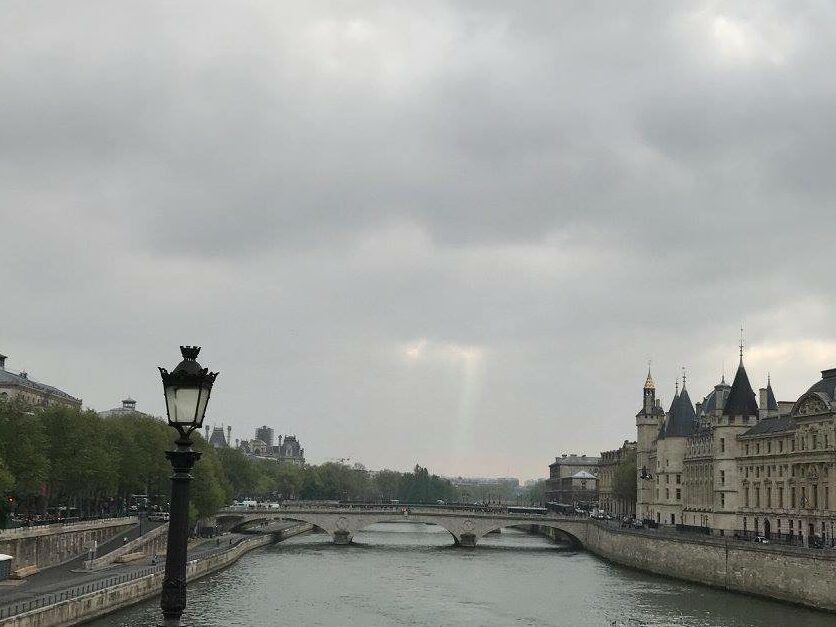
Along the Seine, readers appear the way birds do. Quietly. Without announcement. Some sit against the stone with a book cracked open; others lean on the railings, pages held down by instinct, by habit. The green bookstalls stretch along the river like an honest archive. Used paperbacks, fading magazines, postcards, old maps, and small antiques that feel less bought than adopted. You don’t browse quickly here – You touch spines, you open pages at random. You find a magazine from another decade, a novel softened by other hands, a postcard written but never sent. Hemingway understood this kind of belonging. “There is never any ending to Paris,” he wrote, and here, you feel it. Reading in public. Memory laid out without spectacle. Stories moving on like the river itself, leaving just enough behind to remind you they were here.
Along the Left Bank, I stopped often. I read a bit, and I closed the book. I watched the water move the way it always has. Writers like to say Paris saved them. I think it simply taught them how to pay attention long enough to save themselves.
“That Paris was very beautiful and we were very young.”
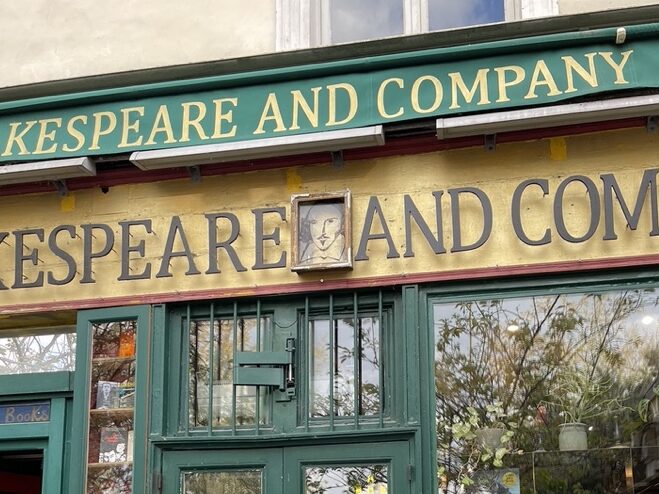
Inside Shakespeare and Company, the rules matter. No photographs. You don’t document this place. You enter it.
The absence of cameras sharpens your attention. You notice the uneven floors. The handwritten notes. The way light settles into the upstairs rooms, where time seems to soften. Cats move through the shelves as if they own the place, sleeping on books, watching readers quietly. They give the shop a lived-in, calm feel, a reminder that literature isn’t precious. It’s domestic. It belongs to daily life.
The original Shakespeare and Company was founded in 1919 by Sylvia Beach, who published James Joyce’s Ulysses when no one else would. Hemingway said of Sylvia Beach, “Sylvia Beach was the only person I knew who never lost enthusiasm.”
The shop became a refuge for writers who needed more than books. They needed belief. When that original store closed during the war, the spirit didn’t disappear. It waited.
The current bookstore was opened in 1951 by George Whitman, who welcomed writers, readers, and wanderers with a simple exchange. You could sleep among the books if you read every day and help around the shop. He called them tumbleweeds. Thousands passed through. Some became famous. Most simply became themselves a little more fully.
Standing upstairs, holding A Moveable Feast, none of that history feels distant. It feels present. Alive. This is not a bookstore that celebrates authors. It celebrates the act of reading, the act of trying.
“You belong to me, and all Paris belongs to me, and I belong to this notebook and this pencil.”
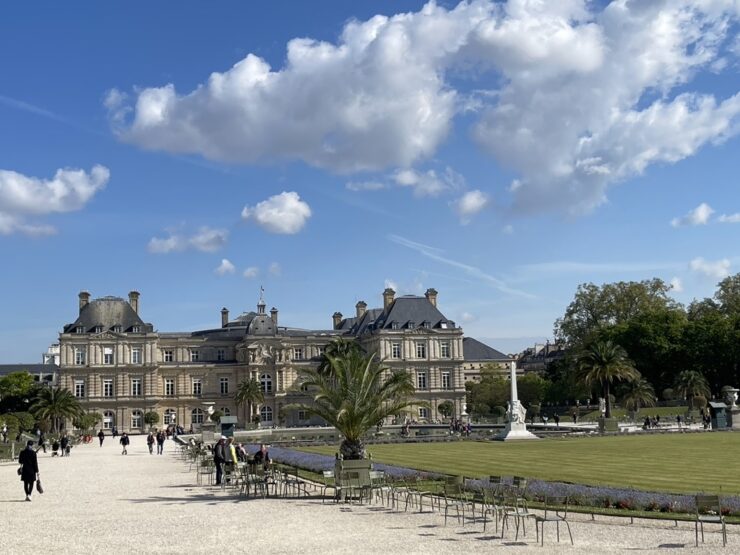
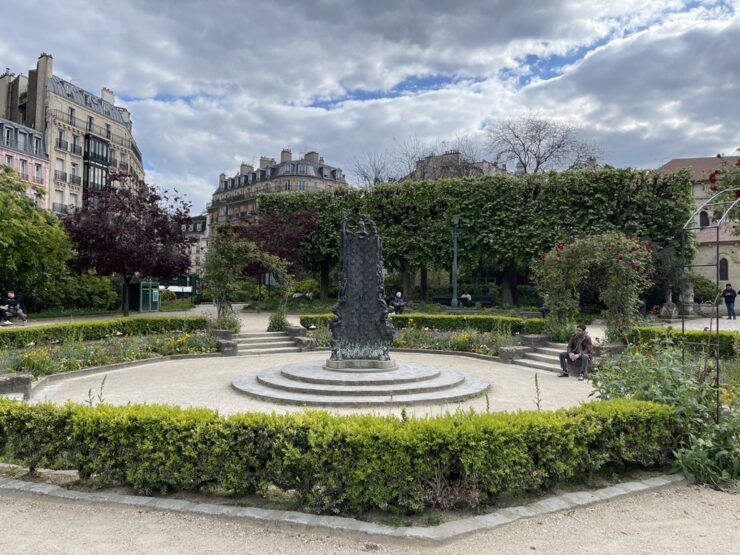
I ended my walk in the Luxembourg Gardens, pulling a green chair into the sun like everyone else who understands time differently here. Children sailed boats. Old men read newspapers. Lovers sat close without performing. This is what the Paris guidebooks miss. The Paris that does not rush meaning toward you, but lets it arrive.
The Luxembourg Gardens are where Hemingway’s Paris drops its last illusion. Before it was lawns and sculpture and postcard romance, it was a place a young writer went when he was hungry: literally hungry. Hemingway spent long afternoons here reading, writing, and watching the world move past him, and when the money ran thin, he trapped pigeons in the park and brought them home to roast.
Poverty sharpened his eye, not bitterly but cleanly. He wrote later, “That Paris was very beautiful and we were very young,” and in the gardens, you feel the truth of that, beauty and hunger living side by side, neither canceling the other. People still sit here the way he did: pulling chairs into the light, reading until the sun shifts, letting the city fold around them. The Gardens hold all of it: the softness, the ache, and the stubborn belief that work and will could be enough.
Hemingway did not write about Paris to make it beautiful. It already was.
He wrote about it to make it livable.
That is what this walk gave me. A way through the city that required neither proof nor performance. Just presence, just noticing, just the permission to exist quietly in a place that has seen everything.
When I left Paris, the book was heavier. Bent corners. Coffee stains. Pages marked not for later, but for remembering how it felt to be there.
Paris is movable if you let it be. Sometimes it’s a city, sometimes it’s a sentence. Sometimes it’s a quiet walk with a book in your bag, teaching you how to see again.
The Map: Walking Hemingway’s Paris
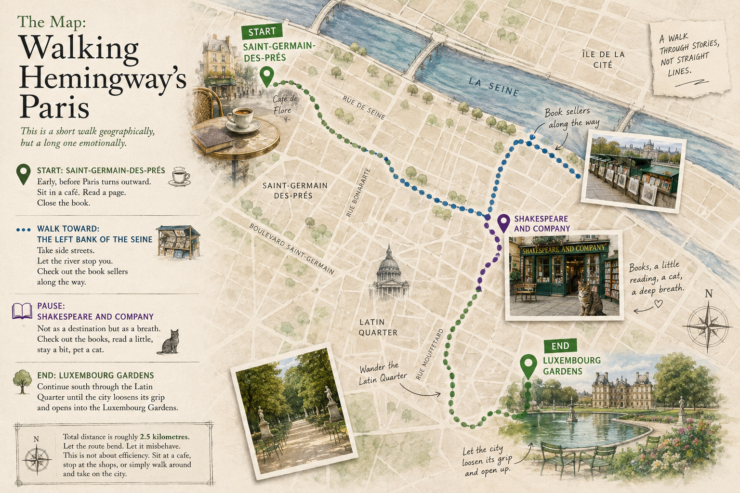
This is a short walk geographically, but a long one emotionally.
Start: Saint-Germain-des-Prés early, before Paris turns outward. Sit in a café. Read a page. Close the book.
Walk toward the Left Bank of the Seine: Take side streets. Let the river stop you. Check out the book sellers along the way.
Pause: Shakespeare and Company. Not as a destination but as a breath. Check out the books, read a little, stay a bit, pet a cat.
End: Luxembourg Gardens. Continue south through the Latin Quarter until the city loosens its grip and opens into the Luxembourg Gardens.
Total distance is roughly 2.5 kilometers. Let the route bend. Let it misbehave. This is not about efficiency. Sit at a cafe, stop at the shops, or simply walk around and take on the city,
Sit. Read. Or don’t.
Let the day end unfinished.
That’s the Paris Hemingway knew.
And somehow, it’s still here.
You Might Also Enjoy Reading
Champagne Tasting in Épernay: A Journey Through the Heart of Bubbly France
Love Knows No Bounds: Exploring France on an LGBTQ+ Cruise
Château de Boursault: A Wonderful Discovery in Champagne
Read more from Mary at Mary in Vancity.
