
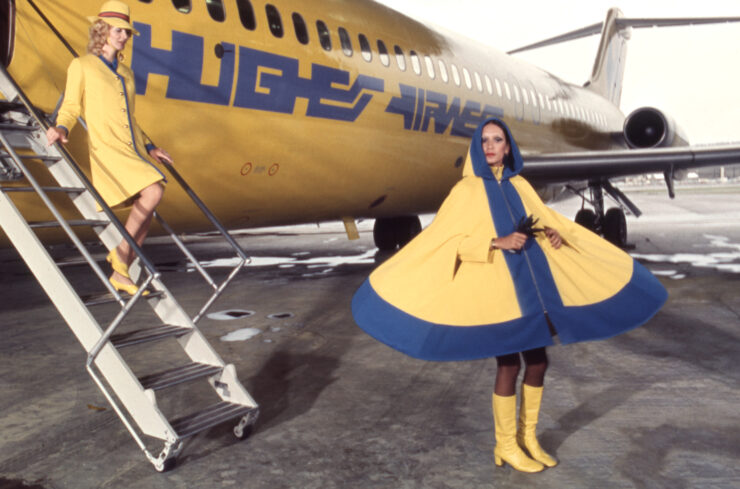
Hughes Airwest unveiled one of the most visually dramatic cabin crew wardrobes of the early 1970s. Designed with a distinctly West Coast, sun-drenched glamor, the airline translated its vivid yellow fleet into a uniform story of equal radiance—part futurist fantasy, part jet-set allure. The result was an image of air travel sophistication that distilled the era’s optimism into something unmistakably chic.
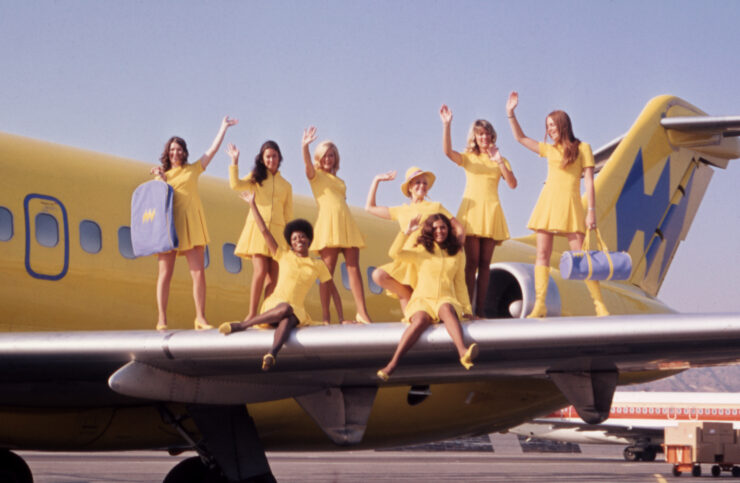
In the air, flight attendants wore a sunshine-yellow, short-sleeved, princess-cut dress. Its long, clean lines are designed to elongate a woman’s body with tailored precision. Skimming over the bust, waist, and hips before landing six to seven inches above the knee, the silhouette balanced discipline with sexiness. Five gold-tone buttons down the front of the matching coat with blue trim added a note of polished embellishment. Yellow-colored pumps and a wide-brimmed fedora completed the look with unmistakable runway poise.
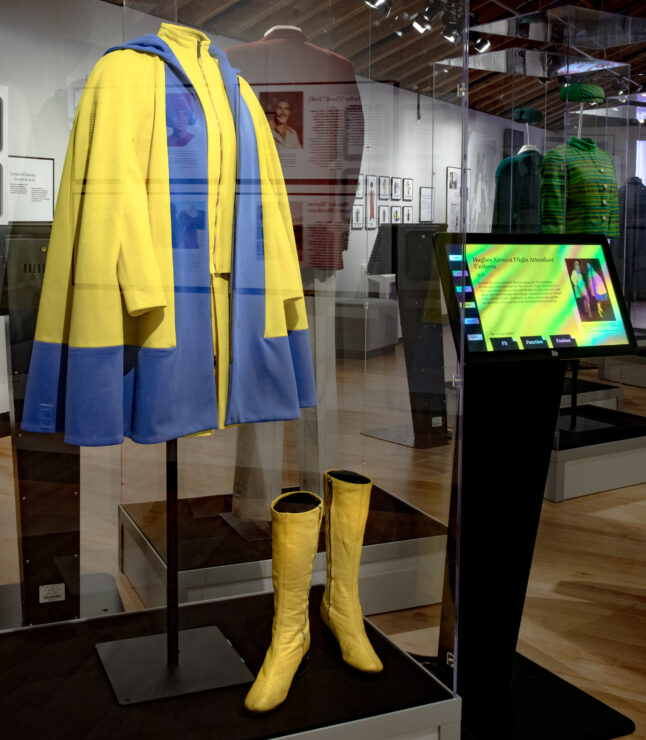
On the tarmac, the ensemble was layered with an elegant, hooded cape in yellow edged with blue. It lent the uniform a touch of cinematic drama and a distinctly couture finish. Styled with yellow knee-high go-go boots, black gloves, and a coordinated purse, the accessories pushed the look beyond mere functionality and into high fashion.
In Hughes Airwest’s world of the 1970s, air travel was not simply transportation—it was theatre, glamor, and fashion.
Runway to Runway
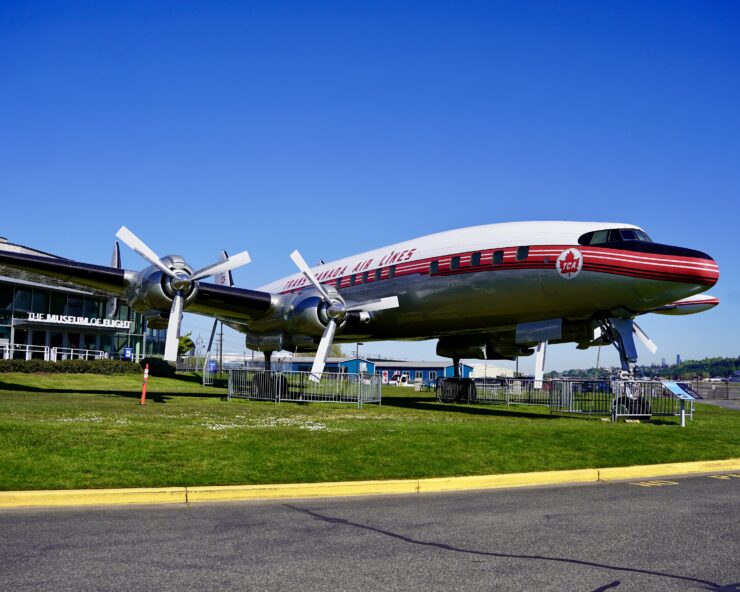
This was just one of 13 striking flight attendant uniforms representing eight airlines featured in Runway to Runway. The exhibition is on view at the Museum of Flight in Seattle, Washington, running through January 18, 2027.
The exhibit brings the golden age of travel to life through flight attendants’ stories, photographs, and uniforms. Visitors learn about United Airlines’ first Black flight attendant and one of Continental Airlines’ first male stewards, who in 1978 had to keep smiling as passengers reacted with surprise to a man in the role.
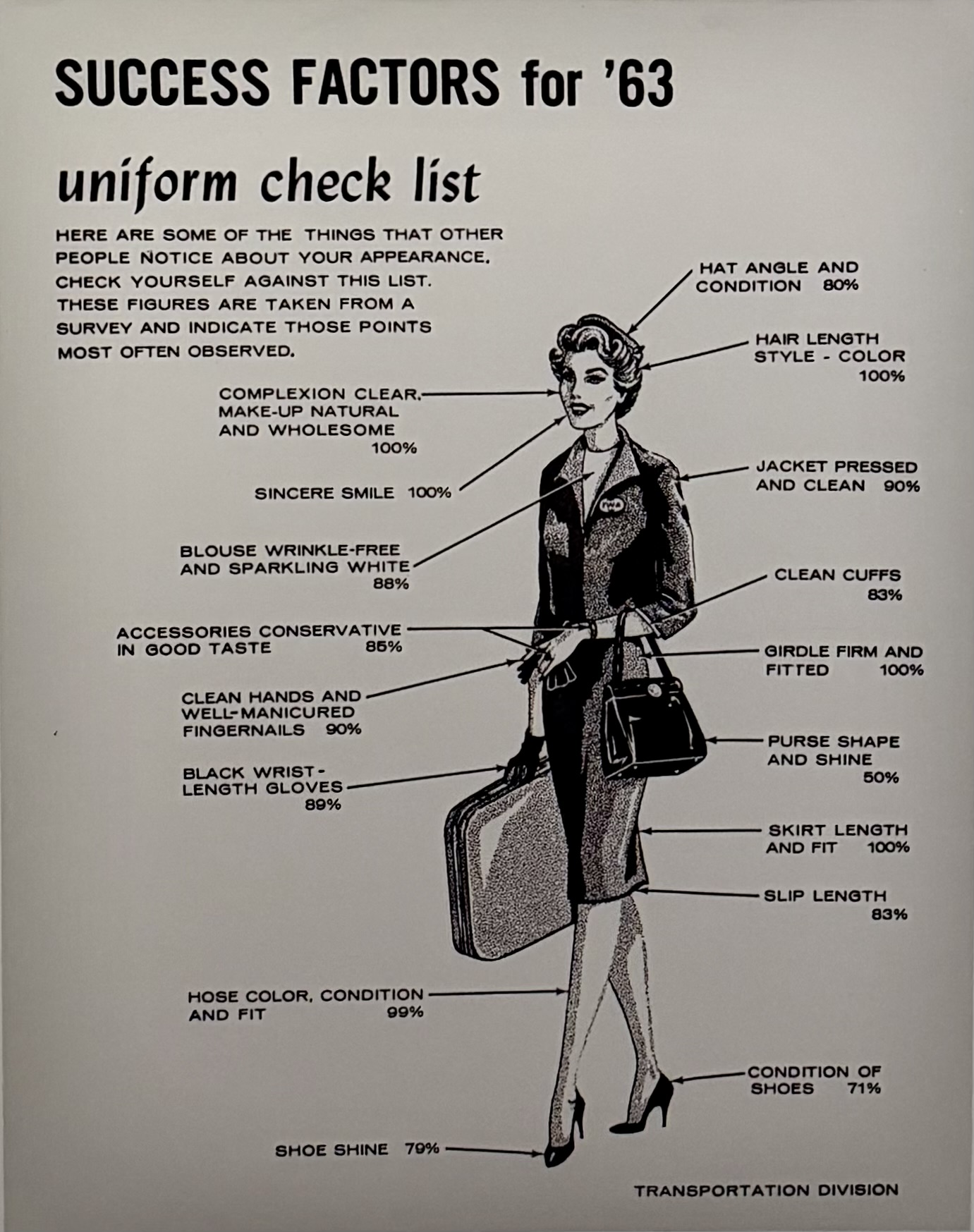
The museum traces the evolution of flight attendant uniforms as fashion and cultural artifacts, using posters and manuals to show how appearance standards were defined.
During my visit, I discovered a distinctive chapter in fashion history: flight attendant uniforms made from modern fabrics, defined by vibrant colors and striking silhouettes.
The Golden Age of Travel
The golden age of travel from the 1950s through the 1970s was synonymous with glamor and luxury. In the 1950s, when ocean liners still dominated many transatlantic journeys, airlines courted Presidents, movie stars, and the wealthy.
Airline passengers were offered endless champagne, caviar, and roast beef carved from carts, all served on fine porcelain with gold-plated cutlery. This was very different from today’s typical airline meal, which often resembles a frozen TV dinner.
The period also marked the rise of the jet age, as aircraft such as the de Havilland Comet, the Douglas DC-8, and the Boeing 707 reshaped commercial air travel. Scheduled transatlantic jet services expanded rapidly. The introduction of the Boeing 747 in 1970 further heightened the sense of scale and spectacle associated with air travel.
Cabin design also reflected a different era of flying. Overhead space was more limited and often consisted of a narrow open shelf for coats and hats rather than enclosed bins. This underscored the sense that the rich did not have carry-on luggage.
Economy class was filled with plush reclining seats with more room between rows. Seat pitch—the distance from one seat to the same point on the seat in front—was often more generous than on many contemporary budget airlines, at 36 to 40 inches, compared with 28 inches today. At that time, high airfares, not passenger volume, sustained the airlines’ profitability while still providing traveler comfort.
During the golden age of travel, commercial air travel was marketed as an aspirational experience. There was an unwritten rule that passengers dressed formally for their flights. Women wore their finest fur coats, and men wore black ties or suits.
Face of the Airlines
During this period, flight attendants became the public face of the airlines. Carriers enlisted prominent designers in New York, Paris, Milan, and Hollywood to create distinctive uniforms that shaped both the cabin crew image and the in-flight brand.
The museum exhibit features designers including Jean Louis, Roxanne of Hollywood, Mario Armond Zamparelli, Valentino, Emilio Pucci, and Edith Head, whose influence extended from uniforms to accessories.
Fashion played a central role in defining each airline’s identity. Designers had broad creative freedom to shape the look from head to toe, from faux-fur caps and three-inch heels to special-edition suitcases, tote bags, and purses. Some collections included more than 50 pieces.
Against this backdrop of luxury travel, airline uniforms became a powerful marketing tool. The exhibition highlights how fashion designers translated the glamor of the jet age into distinctive identities for individual carriers.
Courtesy of the Museum of Flight.
Hughes Airwest
The Hughes Airwest uniform was among the most iconic in aviation history and was one of the exhibition’s most enduring looks. Even now, it reads as strikingly modern—an image of confidence, glamor, and unapologetic style.
Backed by Howard Hughes’s Summa Corporation, the uniform was created by Mario Armond Zamparelli, Hughes’s longtime artistic director. He translated the airline’s bold visual identity into a wardrobe of high-drama sophistication.
As the airline’s own Sundancer magazine declared, the uniforms were “revved up with a classic boldness in beautiful shapes streaming like light over the body.” This description perfectly captures the optimism, spectacle, and theatrical glamor of the Jet Age.
With sunshine-yellow princess-cut dresses, go-go boots, and sweeping capes, the look was designed to command attention, turning flight attendants into movie stars as they moved through the terminal concourse.
Courtesy of the Museum of Flight.
Braniff’s Italian Glamor
Braniff International Airways, founded in 1928, was among the first American airlines to rebrand its cabin crew in the mid-1960s. They became known as the first airline to outfit flight attendants in custom haute couture uniforms.
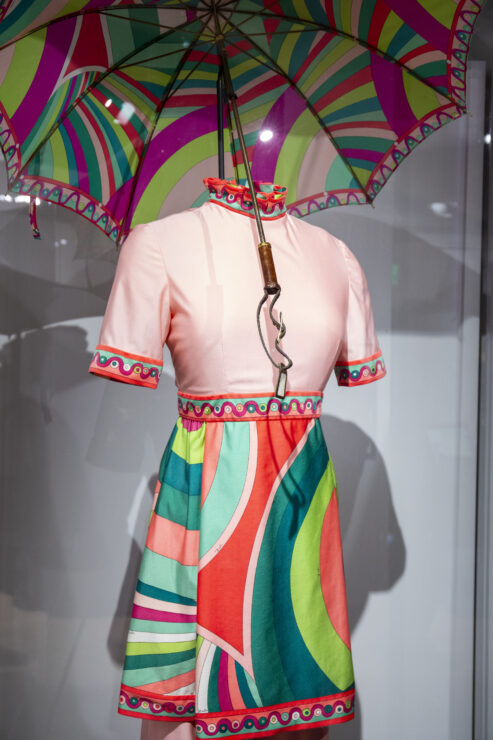
Braniff commissioned Italian designer Emilio Pucci, whose work for the airline spanned from 1965 to 1974 and included six collections. He transformed its uniforms with vibrant colors and geometric patterns, bringing a sense of movement that helped redefine flight attendant style.
Displayed is a Braniff flight attendant dress from Pucci’s 1971 uniform collection. It features psychedelic pink swirls and comes with a matching umbrella. The ensemble consists of a pink empire-waisted dress that can be worn over skin-tight hot pants or wide-legged trousers, featuring either a frilled collar or a square neckline.
These European luxury fashion uniforms reflected Braniff International’s evolution into a truly world-class airline.
Pucci was an Italian designer born in Naples in 1914. He was an accomplished skier, a race car driver, and an Italian bomber pilot during World War II before becoming a fashion icon.
First known as a sportswear designer known for bright, swirling patterns, he soon expanded into blouses, dresses, and scarves made from the same boldly patterned fabric. His distinctive swirls, some of which used as many as 16 colors, took the fashion world by storm. This earned him the nickname “The Prince of Prints.”
United Airlines Mod look
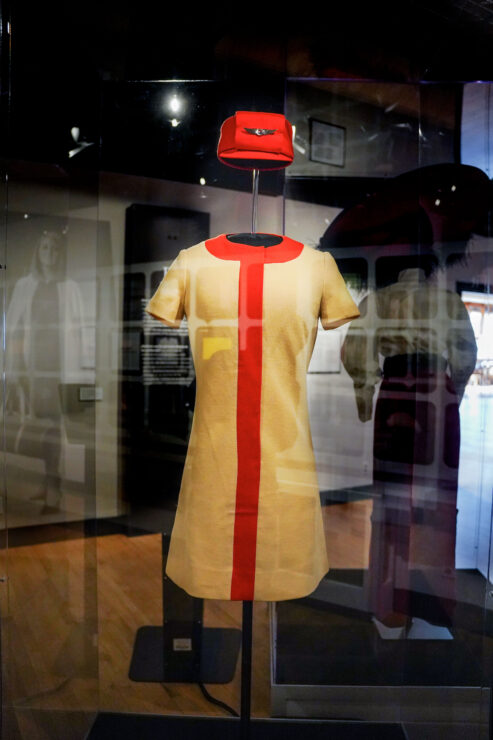
In 1968, United Airlines unveiled its iconic uniform, known as the “skimmer.” It featured a sleek double-knit, knee-length A-line dress available in three color combinations: Miami Sands Ivory, Maliblue, or Hawaiian Sunset.
The A-line dress was a defining icon of the mod era. Its silhouette widens gently from the bust to the hem, skimming past the waist to create the appearance of a capital letter A.
The look was finished with summer and winter coat options, navy pumps for summer, and stylish knee-high boots for winter. It also included white wrist-length gloves, a matching military-style kepi hat, and an optional scarf.
Unique to the industry, there was a fourth in-flight skimmer dress with stripes on the front. This required the stewardess to go to the lavatory in flight to change.
During this period, airlines required flight attendants to wear their street dress uniforms. Which could include their jackets, hats, and heels when the cabin door was open for boarding and deplaning. Once the door was closed, they could remove their jackets and heels for cabin service.
In 1968, Jean Louis, an Oscar-winning costume designer from Hollywood, designed the A-Line dress uniform. He created gowns for icons like Marlene Dietrich, Judy Garland, and Rita Hayworth. Additionally, he crafted the renowned nude-and-crystal gown Marilyn Monroe wore while performing at President John F. Kennedy’s star-studded 45th birthday celebration.
The United Airlines uniform contract was the largest at the time, valued at $3 million. Approximately 4,500 women received the new uniforms, which drew significant attention and were prominently featured in their advertisements.
Jean Louis embraced the Mod fashion scene of the 1960s. Flight attendants had two skirt-length options: standard at the knee or a shorter hemline, popularized by London-based designer Mary Quant’s miniskirts.
Inspired by the mod fashion scene and rock music of the 60s, Jean Louis infused United Airlines with the vibrant, youthful energy of the 1970s.
Flight Attendant Fashion Today
With U.S. airline deregulation beginning in 1978, the industry’s gaze shifted decisively from glamour to price. With survival tied to fares rather than fantasy, the era of fashion-led flight uniforms began to fade. On many budget carriers today, cabin crew are dressed for utility in a cardigan and slacks—a pragmatic uniform language far removed from the polished allure of the jet-set years. In 2027, Delta Air Lines employees will wear uniforms styled by Lands’ End.
And yet, across Asia, Europe, and the Middle East, a select group of flagship airlines still understands the power of fashion to shape an identity in the sky. They contract with celebrated designers to define the visual language of their cabin crews.
Singapore Airlines continues to showcase Pierre Balmain’s iconic “Singapore Girl” sarong kebaya. It was introduced in 1968 and is still instantly recognizable as a symbol of grace in motion.
Virgin Atlantic’s vivid scarlet tailoring—high-collared jackets, pencil skirts and hourglass heels designed by Vivienne Westwood—brings unmistakable attitude and drama to the aisle.
Riyadh Air has introduced rich amethyst uniforms designed by Mohammed Ashi, whose couture sensibility is evident in the sculptural tailoring and luxurious fabrics. The attire blends Saudi heritage with a modern vision of aviation glamor.
The next time you book a flight, choose one of the world’s luxury carriers if you can. Then settle in and watch as the aisle transforms, once again, into a runway worthy of the fashion models of the skies.
If You Go
The Runway to Runway collection brings America’s golden age of travel back to life. It spotlights flight attendant uniforms and artifacts drawn exclusively from the Museum of Flight’s permanent collection. Alongside the exhibition, the museum is hosting public lectures and interactive programs that explore the evolving relationship between aviation and fashion.
On view at the Museum of Flight in Seattle, Washington, the exhibition is open to visitors through January 18, 2027.
You May Also Enjoy Reading
Seattle, Washington: Best Things to See, Do, and Experience
