
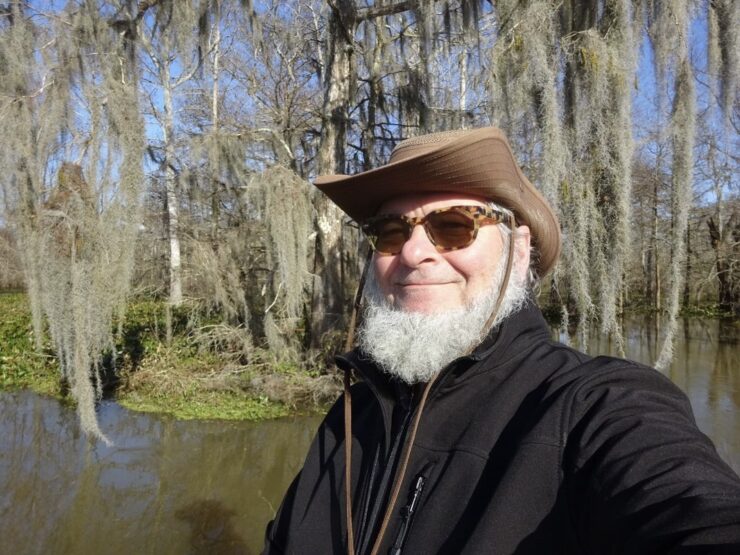
Long before he became known for leading swamp tours through Louisiana’s Atchafalaya Basin, John Burke earned an international reputation for something far less expected: caviar.
In 1985, Burke founded the Louisiana Caviar Company, transforming the eggs of the bowfin—an ancient fish long dismissed as “trash”—into a high-end product praised by top chefs and served in some of the country’s most celebrated restaurants. That unlikely success is what earned him the nickname Captain Caviar.
Captain Caviar – Fishing for Bowfin

Credit: Ryan Hagerty, US FWS
It’s no surprise that Burke entered the fish business, with bowfin (or choupique as it’s known in Cajun country) in ample supply outside his home on the Atchafalaya River. During his university years, while pursuing a law degree, he began experimenting with bowfin through trial and error.
“It wasn’t written in the books. I was the experimenter,” he says. Burke became a skilled fisherman, learning the tricks of the trade.

The size of the haul depends on a few factors, according to Burke. “Mother Nature decides when the eggs are ripe for the taking. It’s not like you turn on a spigot and out comes caviar. It’s where you fish, how you fish, and how many fish are in that area. You have to really know the bayous to know where to set a net,” he says.
But was there money to be made? “The 200-million-year-old species, bowfin, was considered a trash fish when I came along. It had no economic value as far as the Department of Wildlife and Fisheries was concerned,” says Burke.
Burke weighed the pros and cons of producing caviar or studying law. He asked himself some tough questions, like, “How many caviar producers do I know?” and “Did I want to corrupt my mind and soul by being a lawyer for the rest of my life or a caviar producer?” He chose caviar.
Turning Roe into Caviar
As he says, “Turning fish eggs into caviar is no big secret. They’ve been doing it since Aristotle’s time. It’s a matter of taking that process and applying it to the roe, or fish eggs, of this particular species.”
The process involves separating eggs from fatty tissue and adding salt. The flesh of the bowfin is gooey with a mashed-potato consistency, but the roe makes great caviar.
“It’s the freshest caviar in the world during the holiday season from December to February. I could be eating caviar today that was made yesterday.”
Winning Over the Chefs


The photos above (supplied by John Burke) show a few of the many dishes enhanced by his Louisiana Caviar (now marketed as Cajun Caviar).
Burke educated many chefs on his new product. Chef John Folse, an authority on Creole and Cajun cuisine, gave the caviar high praise, calling it superior to the Russian version. Burke sold his caviar in countries including Russia, where his bowfin caviar cost one-tenth of the Russian spread.
After 25 years, at his customers’ request, Burke made a flavored caviar by adding ghost pepper. According to Burke, “You get the caviar flavor on the front end and the ghost pepper on the back end, but without the burn.”
Caviar Body Shots
Burke’s favorite is the spicy caviar, and he prefers to eat it plain. ”You do a shot off the back of your hand, like the back of your thumb, much like a tequila shot with salt. That way we can all share the same spoon,” he says.

In his early days, Burke recalls standing at Commander’s Palace Bar with the owner, Dick Brennan. They were doing caviar body shots with some of the house-produced vodka. Brennan told him, “Anybody can buy an ad in any magazine, but you cannot buy what people say about your product or service.” Burke has lived his life by those words of wisdom in the caviar business.
The Legacy of Captain Caviar

(Courtesy of John Burke)
In 2016, Burke sold the Louisiana Caviar Company to Emeril Lagasse’s wife, Alden, and two other partners. That same year, he turned his focus to leading swamp tours through the Atchafalaya Basin. He purchased Cajun Jack’s and renamed it Captain Caviar Swamp Tours.
By then, he had already reshaped how Louisiana caviar was understood, proving that the roe of an overlooked bayou fish could earn a place at the table. His work helped redefine local luxury and left a lasting mark on the state’s culinary identity—one rooted in curiosity, persistence, and deep local knowledge.
Learn More About Captain Caviar’s Swamp Tours
Learn more about Captain Caviar’s swamp tours and the folklore of the Atchafalaya in this companion article: Tour the Atchafalaya Swamp with Captain Caviar: Ghosts, Pirates, and Louisiana Caviar.
You May Also Enjoy Reading:
From Bayou to Table: A Louisiana Cajun Cooking Pilgrimage
The Louisiana Swamp That Keeps on Giving

