
Captain Rue Denton has seen all there is to see on Florida’s waterways.
The owner of Living Waters Cruises in Winter Haven, Florida, knows most people who’ve made their home on the Chain O’Lakes, either by direct relationship or by reputation. He points out the homes of members of the world-record water ski team – the sport was invented here – whose wooden skis still take pride of place on their jetties. He points out one hulking property with a separate annex as big as most houses.
“That’s the mother-in-law annex,” he observes. “They occasionally let her in during hurricanes.”
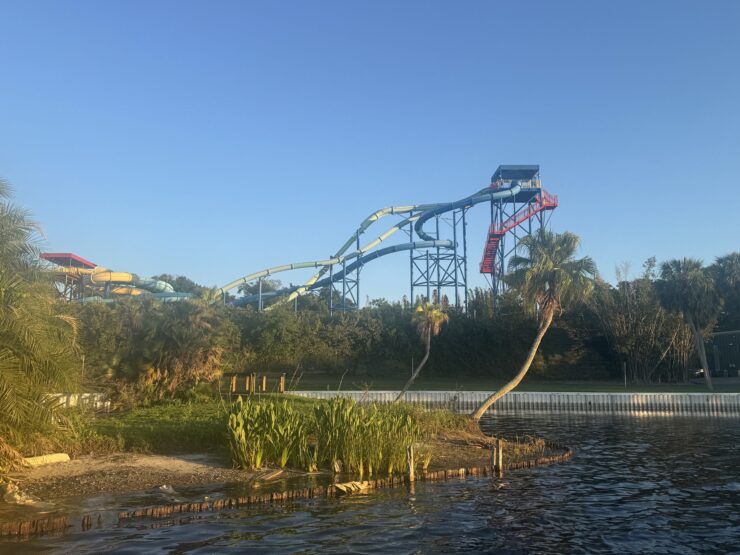
Egrets and herons skitter across the waters, sharing the skies with snake birds, limpkins, and ibis, a surprising confluence of wildlife for an urban lake. In the distance, an unusual yet all too familiar Florida sight emerges above the treeline. A rollercoaster, complete with a sudden drop and loop-the-loop. It belongs to Legoland, which now encompasses Cypress Gardens, the attraction that helped launch Florida tourism long before Disney arrived. The lakes beneath it made that all possible.
Swami of the Swamp
Water is Florida’s defining feature, but not necessarily in the way visitors imagine.
Beyond glitzy beaches and overdeveloped coastline resorts, Florida’s waterways extend to over 3,000 miles. These lakes, rivers, and canals have long shaped settlement, agriculture, and commerce. Before tourists arrived, these waterways carried citrus to market, connected isolated communities, and sustained the ranches that helped build the state. The interconnected Chain O’Lakes is no modern invention. The canals linking the lakes were built between 1915 and the early 1920s to move citrus crops around Polk County. Land now occupied by waterfront mansions was once lined with groves stretching to the water’s edge.
Florida’s waterways became famous after Dick and Julie Pope opened Cypress Gardens in 1936. After World War II, promotional films of visitors boating beneath perpetual sunshine helped create the image of modern Florida tourism. Not bad for a man once dismissed as the “Swami of the Swamp.”
Although now part of Legoland, Cypress Gardens still inspires fierce local nostalgia — everyone went there as a kid, worked there, or learned to swim or water-ski in the area. Rue ran a boat cruise through the gardens in the 1980s.
A Land Remembered
An hour away, Lake Kissimmee tells a different version of the same story of Florida’s waterways. Before railroads arrived, Grape Hammock Landing was one of the region’s key transport hubs. Steamboats traveled through the lakes and river system carrying passengers and supplies, and the surrounding landscape was dominated by cattle drives and open prairie. Florida’s cowboy culture predates the Wild West by several centuries, and ten minutes away, Westgate River Ranch continues to host the oldest running weekly rodeo in the United States.
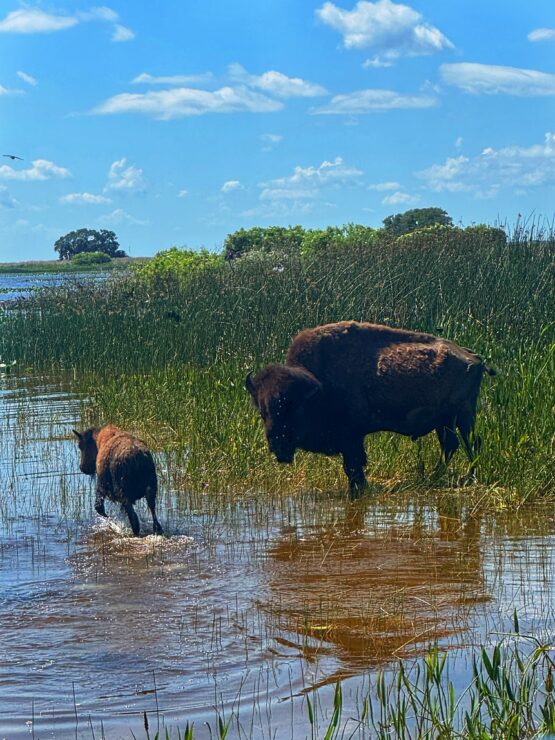
When bridges arrived in 1949, Grape Hammock adapted from steamboat landing to airboat tours, bass fishing, and RV tourism, remaining in the same family throughout. No rollercoasters here, just the largest population of bald eagles in the Southeast and odd wading buffalo.
“This is the only place on Earth where you need to worry about hitting a buffalo with your boat,” observes Captain Barrett Chandley, whose grandparents bought the site in 1950.
It’s unseasonably warm, keeping the gators below the surface. Anhingas circle overhead, using their spear-like bills to catch fish for their nests. Their young flap their white wings like overconfident teenagers, drawing Barrett’s attention.
“Best they don’t fall. The gators know where to wait.”
The unspoiled landscape attracts more than tourists. A Land Remembered, an adaptation of the 1984 historical novel that rivals the Bible for popularity on Polk County nightstands, is being filmed along these same shores. The landscape remains largely unchanged from when the fictional MacIvey family first arrived in Florida in the mid-19th century. Scheduled for release in 2027, it’s expected to prove a tourist boon to the region, especially among visitors craving the nostalgia of “Old Florida.”
Survival At Any Cost
Three hours from Polk County, the waters of the St Lucie River in Martin County know all about nostalgia. Conservation shapes Martin County. Buildings are capped at four stories, and public access to the waterfront remains protected. This preserves the same Old Florida feel as Lake Kissimmee, a sensation rarely experienced on the coast.
Beyond the waterfront communities, stretches of mangroves, oyster beds, and gumbo-limbo trees – nicknamed “tourist trees” because of its perpetually peeling state still preserve a glimpse of the landscape of a century ago.
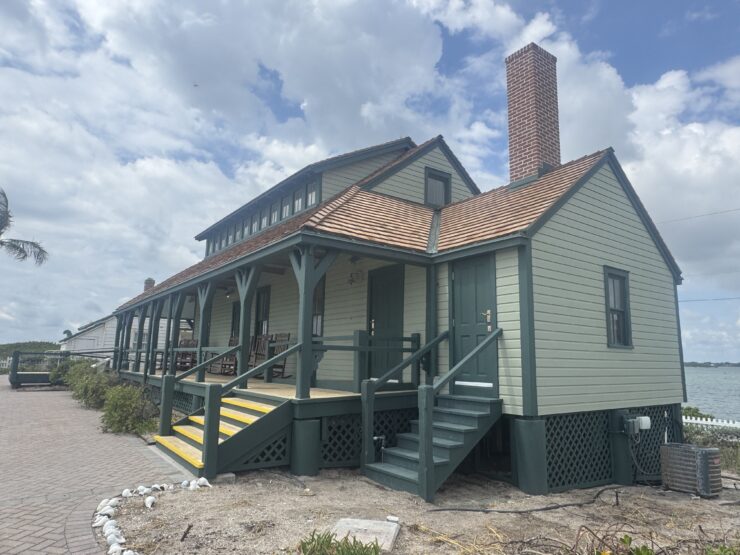
The stories arising from Florida’s waterways here are no less jaw-dropping. Standing on a spit between the river and ocean is the House of Refuge at Gilbert’s Bar, the oldest building in Martin County and the only surviving such house in Florida. Built in 1876, it sheltered shipwrecked sailors who staggered ashore on what was then a largely uninhabited coastline.
As Assistant Keeper of the House, Lindsay Famigletti observes that surviving a shipwreck is one thing, outlasting the Florida mosquitoes and the occasional bear that swam across the river to feast on turtle eggs was another entirely. Originally, ten such houses stood along the coast. This is the only survivor, which is remarkable, particularly given its exposed position to the elements. This leaves it vulnerable to periodic hurricanes. At 17 feet above sea level, it’s practically mountainous in South Florida.
Trapper’s Tales
If anyone is going to rival Dick Pope as the harbinger of Florida tourism, Trapper Nelson is the most worthy candidate.
Like Pope, his story also owes much to Florida’s waterways, and like Pope, he understood the power of celebrity to attract tourists. His homestead, located on the Loxahatchee River inside Jonathan Dickinson State Park and built after he moved south from New Jersey, remains a classic slice of the pre-Disney Florida tourism story.
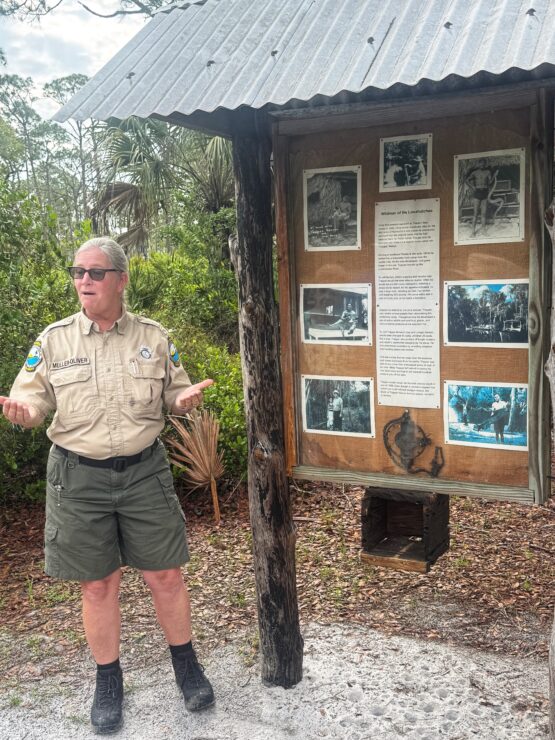
The riverbank leading to his homestead is a web of mangroves, propped up on spindly, arched branches like expectant spiders, alongside Dade County pines unique to Florida. The park protects one of the largest remaining fragments of natural Florida in the region, a narrow ribbon of authentic landscape along the river.
Nelson built a jungle homestead that became a tourist attraction during the 1940s and ‘50s. He entertained visitors by swinging Tarzan-style onto arriving boats and wrestling his three-legged alligator, Stumpy. His unexplained death in 1968 only deepened the legend, increasing further after a fortune of $1,800 in silver coins was discovered in his fireplace. The question I have is why he sought out such an inhospitable landscape given the humidity, bugs, and isolation. Our guide has heard this question before.
“Obviously, you’ve never been to Trenton.”
Gator Alley
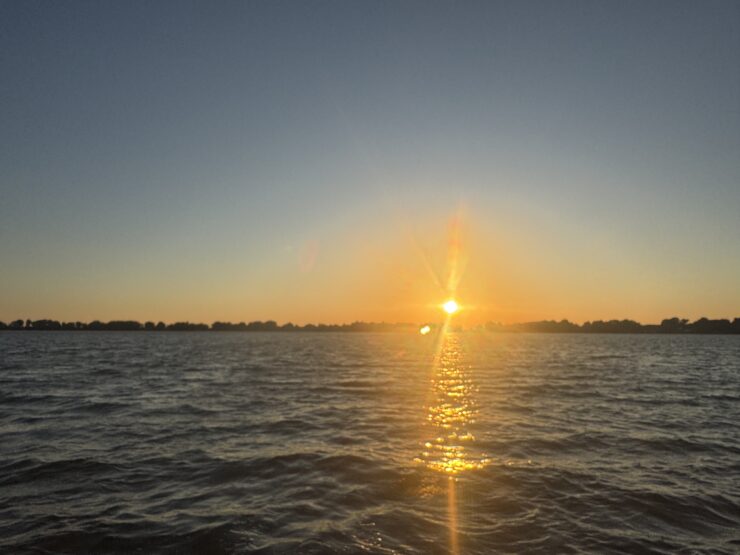
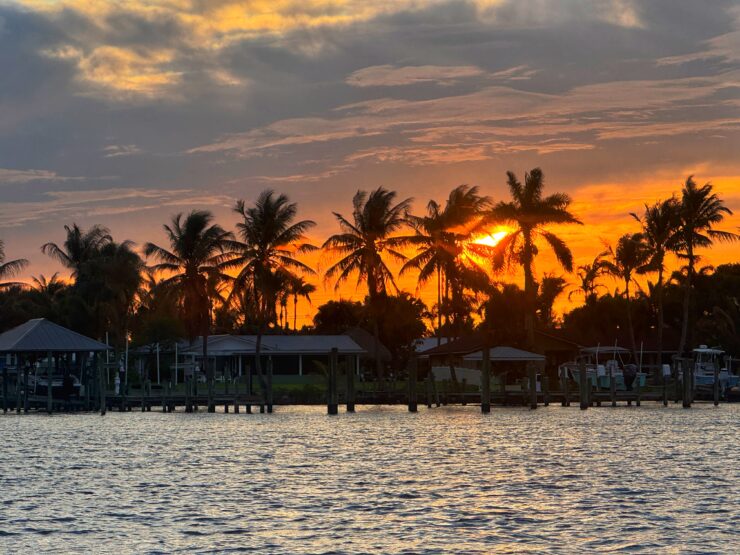
Back on Lake Kissimmee, the sun is setting rapidly. One nearby canal is nicknamed Gator Alley. Captain Rue explains that shining a flashlight on the waters will elicit a hundred reptilian eyes staring unblinkingly back at you.
Gators remain a huge tourist draw in these waters, but you never feed them. Start doing that, and they’ll associate human presence with food. In turn, a dangled limb over the side of the boat is an invitation to snack on a finger or two.
Hearing this, I ask Captain Rue the obvious question: Don’t the local swimmers or skiers ever get nervous about sharing these waters with apex predators?
“Nah, you’d be fine,” he replies with a glint in his eye. “Gators prefer slower prey. Like golfers.”
If You Go
Polk County
Polk County has its own airport (Lakeland Linder International) with regional services to Atlanta, Nashville, and San Juan, among others. Most visitors will likely arrive in Orlando or Tampa, both about an hour’s drive from Lakeland. The Chain O’Lakes, the biggest stretch of Florida’s waterways, is best accessed from Winter Haven.
Staybridge Suites Winter Haven is a block away from Lake Howard (and another five hotels are within a two-mile radius). It offers modern, comfortable rooms and an excellent, fresh breakfast.
Lakeland has a surprisingly sophisticated food scene, with Nineteen61 at the top of the list. Recently recognized by Michelin, the Latin-American-inspired menu is playful and flavorsome. The croquetas in guava glacé and vaca frita will make you question every other meal you’ve eaten in Florida. The upstairs cocktail bar is also worth a nightcap.
Martin County
Stuart, Martin County’s principal town, is a 90-minute drive from Ft. Lauderdale Airport and about two hours from Miami Airport. It’s about 2¼ hours to drive between Stuart and Winter Haven.
Marriott Hutchinson Island is located on the same sliver of land as the House of Refuge. Large suites, a pool, two restaurants, and an undoubtedly scenic on-site golf course..
This close to the coast, it would be rude not to indulge in a seafood feast. Conchy Joe’s in nearby Jensen Beach is as good as it gets. The blackened Mahi and conch chowder will make your heart sing.
Phil’s visit was supported by Visit Florida, Visit Central Florida and Discover Martin County
Read more from Phil on his blog, Someone Else’s Country and follow him on Instagram, Facebook, and Bluesky.
You May Also Enjoy Reading
- A Journey Through Bok Tower and Florida’s Hidden Landscapes
- Why Florida Theatre is Jacksonville’s Must-Visit Landmark
- A Date Night to Remember at the Fat Tuscan, Gainesville, Florida
