
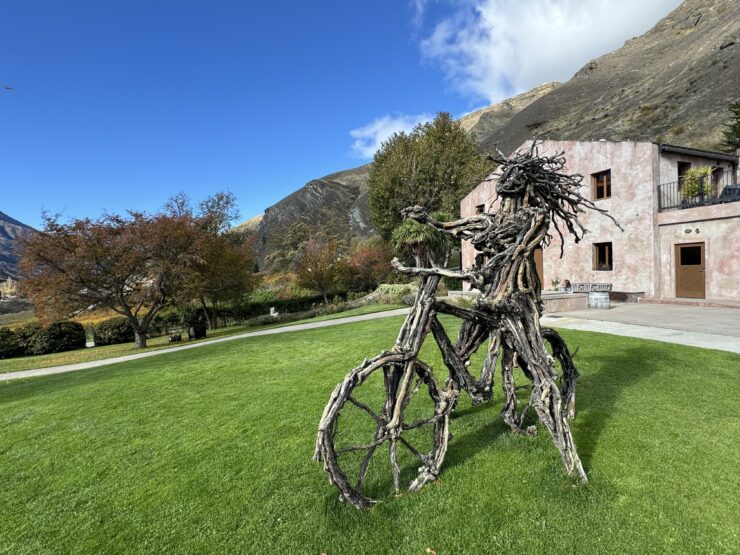
On a crisp mid-Fall day, Chard Farm could pass for the textbook definition of vineyard perfection.
The centerpiece is an elegant farmhouse with manicured gardens, set against hills burnished by seasonal color. Guests sip translucent Pinot Gris or acidic, garnet-tinged Pinot Noir in the garden over upturned barrels, the air carrying a soft breeze and contented murmurs.
Then comes a distant scream.
It slices through the lazy afternoon, heads turn, glasses pause mid-sip. Running parallel to the estate is a sheer gorge carved by the turquoise Kawarau River. Perched 400 feet above it, the AJ Hackett Bungy Centre flings thrill-seekers into the abyss. It’s one of New Zealand’s highest jumps, and a reminder that even within a Central Otago wine tour, adrenaline is the main draw to tourists.
As original pairings of vineyard and vertical drops go, this is hard to beat.
Half a World Away
Central Otago, on New Zealand’s South Island, surprises for one simple reason. What you see and what you taste shouldn’t coexist. Driving here is less rolling-hill Tuscan charm and more a collision of alpine ridges, glacial rivers, and roadside gorges.
The scenery is as cinematic as you’d expect from the landscape immortalised in the Lord of the Rings trilogy. Locals comment that, with an acidity that matches the wines, their biggest road hazard is tourists slamming on the brakes for photos.
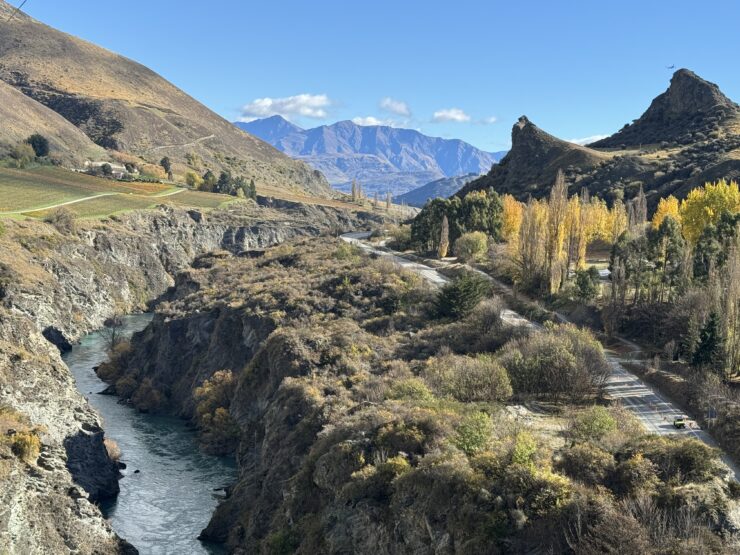
High-quality wine is improbable in such terrain. Most visitors associate New Zealand with Marlborough’s grassy and bright Sauvignon Blancs, a ten-hour drive north. Yet, at 45 degrees south, a Central Otago wine tour drops you in the heart of the world’s most southerly major wine region.
It has a rare continental climate. Warm, dry days, cold nights (every winery deploys frost fans to prevent the grapes from freezing), and soils of schist and quartz that restrict yields and intensify flavor. Around 80 percent of plantings are Pinot Noir, producing wines of vivid fruit, fine tannins, and mouth-watering acidity.
A Landscape That Demands Exploration
While bungy jumping was, quite literally, a step too far for me, Chard Farm became my calm interlude in what was becoming a distinctly hyperactive road trip.
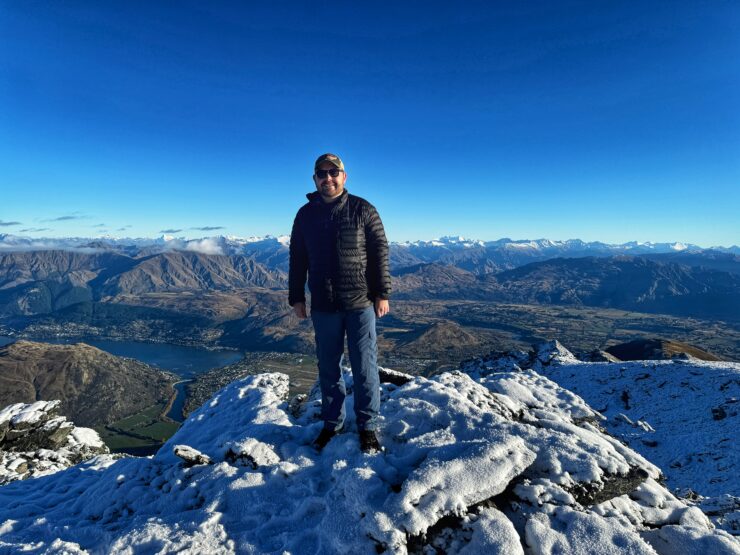
The region and its largest city, Queenstown, brand themselves as the Adventure Capital of the World—billboards around town advertise skiing, hiking, bungee jumping, canyoning, and ziplining tours. On the day I visited Chard Farm, I’d already been dropped by helicopter onto the appropriately named snow-rimmed Remarkables mountain range, Queenstown yawning far below. One of only two global mountain ranges to run north to south, the birds-eye view of Lake Wakatipu is a landscape straight out of a fantasy novel.
Back at ground level, my day continued with 360-degree spins on the Māori-owned Shotover Jet, a 90 km/h jetboat ride through a canyon so tight the cliffs blur into streaks of ochre. Our guide, Joe, grinned as he recited a Māori proverb he was especially fond of: “Kaua e mate wheke, mate ururoa” — don’t die like an octopus; die like a hammerhead.” After half an hour of aquatic whiplash, I feel distinctly cephalopodic and feel like I’ve had quite enough death-defying for one day.
A glass of Pinot called.
A Tale of Collective Success
Many Maori proverbs prize collective success over individual glory, an apt metaphor for Central Otago’s winemakers. The limestone-based soils have parallels with Burgundy. An official exchange between the regions helped grow local expertise and confidence over the past two decades.
From roughly 40 wineries in 2000, there are now about 140. Collaboration seemingly outpaces competition in the desire to get Central Otago’s wine culture known beyond its borders. Many of the new wineries are based around farmhouses, which have replaced previous industries. Mount Rosa in Gibbston traded sheep for vines at the turn of the century because, in their own words, “wool prices were crap!” Their range has expanded from the ubiquitous Pinots to include Gamay, a light and aromatic red, which is growing in popularity in cooler climate regions.
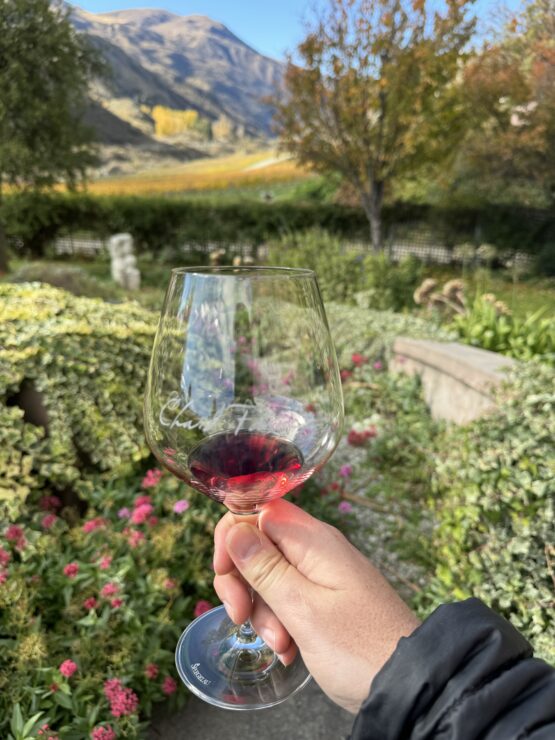
Earlier this year, Vogue spotlighted Central Otago for its “prized Pinots and wild, cinematic terrain.” Award-winning winemaker Jen Parr is an evangelist for the region, describing the output as “terrestrial energy in liquid form.” Her Pinot Noir from Valli Wine shimmers in the mouth with red berries, wild herbs, and cedar notes blending smoothly.
More Stops On The Central Otago Wine Tour
Mount Difficulty, named after a hapless Victorian shepherd, is the next stop on my Central Otago wine tour. They craft another luscious Pinot Gris with peach and nectarine notes and a lingering grapefruit finish. The surrounding landscape is equally impressive. Long, cool fall days cause the landscape to burst into color in every direction and provide the ideal climate for the balanced acidity and complex finish of these wines.
My sommelier smiled as I asked about the eye-catching name of the winery: “It’s based on history, but probably isn’t a bad metaphor for trying to grow grapes here. But we manage.”
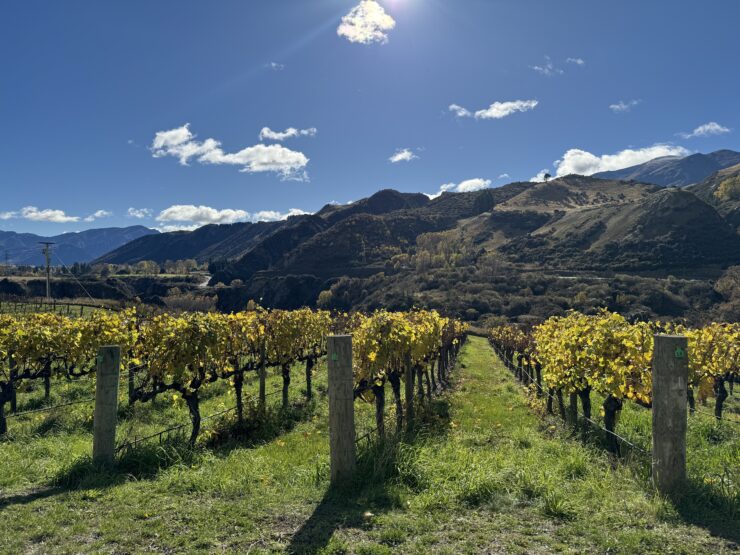
A typical Kiwi understatement for a wine boasting a five-star Decanter review. Or as another Māori saying goes: The sweet potato doesn’t boast of its own sweetness.
Having torn myself away from another glass, my final morning in Central Otago is an early start.
The Cloud of The Dawn
The town of Wanaka is a pleasant 45-minute drive from Valli and Mt. Difficulty, through weaving vineyards and serrated peaks. The most popular hike is the schlep up Roy’s Peak in time to meet the sunrise. It’s easily marked but requires a head torch, not least because the path is occasionally blocked by large cows blinking with indignation at being dazzled.
Māori legends of creation tell of Te Ao (light) spreading across the world to provide a perfect sequence of Te Ata (the dawn), Te Maku (the dew), and Mahoranuiatea (cloud of the dawn). On this climb, I watch this legend unfold in real time. The cloud casts a net over Lake Wanaka beneath us, with shards of light from the town peeking through.
The most popular photo spot is an outcrop over the lake, five kilometers along the trail. Several tourists have already assumed positions to capture the optimum photo, lenses locked onto the horizon. When the sunrise arrives, it reaches across the sky, illuminating the clouds as though they’re smoke. It’s hard not to feel in awe.
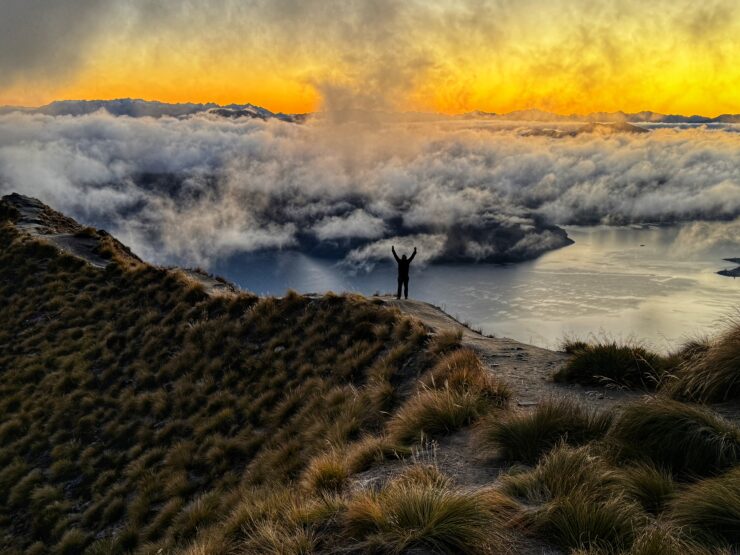
A couple from Australia approached to ask me to snap a photo. As they hand back their camera, they pass me a plastic cup. From the depths of their rucksack, they pull out a bottle of Chard Farm 2019 pinot gris, the exact wine I had been sipping the previous afternoon, screams and all.
The creamy texture and stone-fruit notes, combined with the dawn views, rapidly become my definitive memory of New Zealand.
The couple registers my surprised expression.
“We wouldn’t normally at this time of morning,” explains the wife, “but if you can’t have a glass with this view, when can you?”
“True,” the husband interjects, “plus, we’re bungee jumping later, and I need all the help I can get.”
If You Go
Most visitors arrive in Queenstown on domestic flights from Auckland (a 2-hour flight). Several airlines also fly direct to Sydney, Brisbane, and Melbourne. Wanaka is an hour’s drive from Queenstown.
Car rental gives you the most freedom to explore the landscape at your own pace. Without one, multiple Central Otago wine tour options are available. Queenstown’s own visitor website has comprehensive listings for every adventure activity available in the region.
You May Also Enjoy Reading
New Zealand’s Delightful Wine Village
Waiheke – New Zealand’s Wine Island
Read more from Phil on his blog, Someone Else’s Country, and follow his journeys on Instagram.
